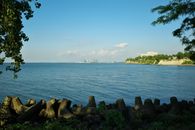
For generations, Cleveland’s downtown and its lakefront have been separated by more than distance. Highways, railroad tracks and difficult crossings have made Lake Erie visible without making it easy to reach.
Now the city is preparing to build a land bridge, convert part of State Route 2 into a slower boulevard and create a new connection to the Port of Cleveland. The public promise is simple: reconnect Cleveland to its lake.
The harder test begins with the construction documents, financing plan and maintenance bill.
The project is entering its consequential stage
The North Coast Connector is planned as a phased project linking downtown Cleveland with the Lake Erie waterfront. Its first construction package includes a land bridge over railroad and roadway infrastructure, the conversion of the Shoreway between West Ninth Street and east of East Ninth Street, improvements to the West Third Street Bridge, dedicated port access, sidewalks and multi-use paths.
Cleveland says construction is slated to begin in 2027. The city and its partners are also recruiting contractors, suppliers, consultants and local companies for the work. That means the project is no longer only a long-range planning concept. It is moving toward procurement, design development and the administrative decisions that determine what can actually be built.
At the same time, the federal Permitting Dashboard lists environmental review and permitting as in progress, with an estimated completion date of October 22, 2027. That schedule does not establish that construction will begin on time. It does show that the project remains inside an active regulatory process while the city prepares for a 2027 start.
Funding is substantial, but not the same as completion
The first construction package is estimated at approximately $284 million. Cleveland says it has secured more than $150 million in state and federal grants, including nearly $60 million through the federal INFRA program, nearly $70 million through the Reconnecting Communities Pilot Program and $20 million from Ohio’s State Community Investment Fund.
The city’s grant announcement describes the funding as a major step toward the lakefront transformation. That is fair. Outside money has moved the project well beyond the stage of an unfunded civic aspiration.
But grant awards do not answer every financial question. The public record supplied for this story does not yet establish the final construction cost after design development, the complete financing plan for the remaining gap, the structure of any debt or reimbursement obligations, or the city’s long-term operating and maintenance costs.
Cleveland’s procurement materials say officials are still coordinating National Environmental Policy Act approval, identifying utility relocations, determining right-of-way needs, obtaining permits and preparing a financial plan involving Federal Highway Administration funds. The city anticipates using a progressive design-build model, meaning important design, cost and construction decisions may continue to develop after the initial procurement stage.
That is not evidence that the project is failing. It is evidence that the most consequential commitments have not all been made.
A complete vision may arrive in pieces
The North Coast Connector is part of a broader lakefront redevelopment framework involving roughly 55 acres, including parking areas, the current football-stadium site and potential future mixed-use development.
That larger vision matters because the first construction package is not the entire transformation. The city describes a second phase east of East Ninth Street that will proceed after additional construction funding is obtained.
A project can therefore be publicly understood as a complete reconnection while only part of the system is financed and ready to move. The difference will matter to pedestrians, port users, nearby businesses and residents who experience the project as a network rather than as a rendering.
The city says the existing crossings at East Ninth and West Third Streets create safety problems where cars, trucks, bicycles, scooters and pedestrians meet. It also says those crossings are difficult for people with disabilities. A safer and more accessible connection would provide a real public benefit even if the private development projected around it arrives slowly.
But the city’s own materials describe housing, hotels, restaurants, retail and tourism as opportunities the boulevard and land bridge could create. Those are development possibilities, not guaranteed outcomes.
The transportation questions are still open
Cleveland says the boulevard would have a speed limit of no more than 35 miles per hour and generally include two through lanes in each direction, with a dedicated left-turn lane at intersections. The city also expects some traffic to divert to other roadways, including Interstate 90.
Those choices place several systems in the same corridor. Port freight must remain dependable. Downtown traffic must continue moving. Pedestrians and cyclists need crossings that are safe in ordinary conditions, not only during planned events. Transit riders and visitors arriving without cars need a route that is understandable and usable.
The research supplied for this article does not establish the final traffic effects, the expected delay or diversion, or how freight movements will interact with the pedestrian and bicycle network. Those are not secondary design questions. They will determine whether the connector functions as public infrastructure or simply shifts congestion and operating costs elsewhere.
The public obligation begins after the ribbon cutting
The most important unanswered question may be who maintains the connection once construction ends.
A land bridge requires landscaping, lighting, drainage, snow removal, security, accessibility maintenance and repairs. A redesigned boulevard requires pavement work, signals, sidewalks and traffic management. Port access requires dependable operations even when public activity around the lakefront changes.
The city has not yet publicly established the complete long-term cost of those responsibilities. Nor has it shown how maintenance will be funded if private development is delayed, reduced or concentrated in higher-value projects that do not produce the expected public revenue.
This is where Cleveland’s project becomes relevant beyond Ohio. Cities across the country are using federal reconnecting-communities grants and other infrastructure programs to repair divisions created by highways, rail lines and industrial development. The projects often promise housing, tourism, public space and private investment at the same time.
The question is not whether those benefits are possible. It is who remains responsible if they arrive slowly, unevenly or not at all.
A public lakefront should be measured in public use
Cleveland has identified a genuine access problem and secured significant outside funding to address it. The North Coast Connector could make the waterfront easier to reach, improve mobility and create a stronger relationship between downtown institutions and Lake Erie.
But the project should not be judged only by its grant total, construction start or future development map. It should also be measured by whether residents can use it without a car, whether people with disabilities can navigate it safely, whether port operations remain reliable, whether local firms receive meaningful work and whether the city can afford to maintain what it builds.
The next important disclosures will not be another rendering. They will be the first contract, the first revised cost estimate, the traffic model, the utility-relocation plan and the explanation of who pays when the construction crews leave.
Cleveland’s lakefront is moving from vision to obligation. The city has secured enough support to begin building. Now it must show that it can make the connection work every day.