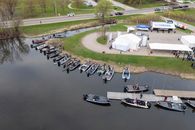
Banks Shaw and Jake Lawrence were more than four pounds behind when the final period began. Two hours later, they had caught nearly 27 pounds of bass and won Major League Fishing’s Challenge Cup with 38 fish weighing 62 pounds, 10 ounces.
That comeback tells us something important about the tournament. It shows that the format rewarded anglers who could find a workable pattern, communicate with a teammate and adjust under pressure.
It does not tell us that Lake Tawakoni is healthy. It does not settle the argument over forward-facing sonar. It does not prove that Rains County received a measurable economic benefit.
The Challenge Cup was a controlled test of competitive fishing. The lake was something else entirely.
Secret water changes the job
The event ran from November 15 through November 20 in the Emory, Texas, area. Twelve two-person teams competed through elimination, knockout and championship rounds. There were no practice days, and competitors were prohibited from intentionally obtaining or sharing fishing information about possible tournament waters within 60 miles of the city center after the location was announced.
That was more than a television gimmick. It removed the ordinary advantage of spending days graphing a particular lake, checking a creek arm or identifying the one stretch of shoreline that might save a tournament.
But secret water did not mean no information. The anglers still brought seasonal knowledge, electronics, tackle systems, weather awareness and the ability to read water. The advantage shifted from knowing the lake to learning the lake quickly.
That distinction is useful outside professional competition. A fishing report, a lake’s reputation or a successful trip from last year can help with preparation. None of them removes the obligation to pay attention to the water that is actually under the boat that morning.
Shaw and Lawrence’s comeback is the clearest evidence of what the format demanded. Their winning pattern involved shallow boat docks and a particular combination of depth, color and proximity to the main lake. They did not win by remaining loyal to a plan that had stopped working. They found something usable and executed it late.
The format was controlled, not simple
Major League Fishing supplied the boats and assigned officials to manage scoring, rules, communications and catch documentation. The Starlink Team Series rules also made SCORETRACKER connectivity part of the competition. Teams could not knowingly remain in an area without a connection for more than 15 consecutive minutes. A fish caught after the permitted period would not count.
That changes the meaning of equipment and infrastructure. A team might find productive water and still have to leave if the scoring system could not verify the contest. Connectivity was not merely a broadcast convenience. It became part of the playing field.
The supplied boats and officials also created a cleaner television product than ordinary fishing. Competitors did not have to make every independent decision about boat selection, scoring, communication or event logistics. That does not make the fishing easy. It means the difficulty was designed and managed.
In ordinary fishing, a pair of anglers may choose a boat, manage fuel, deal with a mechanical problem, decide whether to abandon a bad area and handle the consequences without an official nearby. The Challenge Cup tested a different set of pressures: rapid adjustment, cooperation, rule compliance and performance inside a controlled operating system.
Two people independently fishing their own tournaments will waste time. The strongest teams have to disagree without turning the disagreement into a second problem. That is a real skill, and the secret-water format exposed it clearly.
Technology still mattered
The event did not represent a return to technology-free fishing. Earlier competition on Lake Fork leaned heavily on offshore fishing and forward-facing sonar. One team reported catching suspended bass in 20 to 30 feet of water with sonar-assisted finesse presentations.
That is consistent with the lesson from my earlier reporting on live-imaging sonar: a screen can show an angler where a bass is, but it cannot choose the presentation, control the boat or explain whether the fishery can absorb more efficient fishing.
In this tournament, the technology helped competitors interpret unfamiliar water quickly. It did not tell them which fish were worth pursuing, when to move, how to work together or how to recover when a pattern failed.
The equipment changed the problem. It did not eliminate the problem.
That matters because the tournament results should not be used as proof that sonar is harmless or that it has already damaged either fishery. Those are separate questions requiring catch-and-effort information, fish-health observations, release-mortality evidence and longer-term biological monitoring.
The fishery beneath the show
The championship round took place on the southern portion of Lake Tawakoni, while earlier knockout competition occurred on Lake Fork. Those are real fisheries with their own habitat, management history and public uses. They are not interchangeable stages.
Texas Parks and Wildlife Department’s Lake Tawakoni survey describes a roughly 37,000-acre reservoir supporting largemouth bass, striped and hybrid striped bass, white bass, catfish and crappie. The lake also supports municipal water use and recreation. Standing timber, docks, limited vegetation and open-water habitat all shape how anglers use it.
Those details matter because tournament weights are observations, not a reservoir-wide census. A 62-pound championship catch tells us what four elite teams caught under a particular set of rules and conditions. It does not tell us how many bass were present, how many fish were pursued and released, how many died afterward or whether future catchability changed.
That is not a criticism of Major League Fishing. It is simply the difference between a tournament result and a fisheries assessment.
Catch totals can be useful to managers if they are accompanied by reliable effort data and transparent methods. The practical questions are what MLF recorded, what it can share with TPWD, and whether the information can be compared with electrofishing, creel surveys and other fisheries-monitoring tools.
The economic claim needs records
A large tournament can bring visitors, lodging demand, fuel purchases, restaurant traffic, marina use and attention to a community. Those are reasonable possibilities. They are not the same as a verified economic impact.
The event’s published results do not establish total attendance, local spending, hotel occupancy, sales-tax receipts, public costs or the number of businesses that benefited. Promotional value may be real without being measurable in the way a county budget or sales-tax report is measurable.
The same rule applies to claims about repeat tourism. A tournament can fill rooms for a few nights and still produce little long-term change. To know whether the event benefited Rains County, officials and organizers would need to identify who came, what they spent, what public resources were used and whether visitors returned after the cameras left.
That information is worth seeking. It should not be assumed because the event looked successful on television.
What the tournament actually proved
The Challenge Cup proved that elite anglers can prepare for a region without preparing for one exact lake. It showed that local familiarity can be limited without removing the need for skill. It rewarded teams that recognized useful information quickly, made decisions under pressure and kept working after the first plan failed.
It also showed the limits of a controlled competition. The boats, officials, scoring system, connectivity requirements and restricted information created a defined test. That test can tell us who performed best under those conditions.
It cannot tell us whether the lake is unlimited, whether technology has no biological cost or whether the surrounding community received more value than it provided.
The tournament’s uncertainty was carefully engineered. The fishery’s uncertainty was not. Weather, water temperature, fish distribution, habitat, prior fishing pressure and long-term population trends remain outside the production plan.
The anglers had to find the fish. Managers still have to find out what the catch meant.