The Supreme Court’s November 9 order allowing the Trump administration to resume border-barrier construction in Texas’s Big Bend Sector was not a final declaration that the government’s project is lawful. It was, more importantly, a decision about jurisdiction, timing and the balance of practical power.
In Mullin v. Friends of the Ruidosa Church, the Court held that a federal district court lacked jurisdiction to decide the challengers’ claim that the Department of Homeland Security exceeded its statutory authority when it waived environmental and other legal requirements for border construction. The Court’s per curiam opinion said the claim was statutory, not constitutional, even though the challengers framed it through the major-questions doctrine.
That distinction is consequential. Section 102 of the Illegal Immigration Reform and Immigrant Responsibility Act gives the Homeland Security secretary broad authority to construct border barriers and roads in areas the secretary determines have high levels of illegal entry. It also permits the secretary to waive legal requirements considered necessary for expeditious construction and sharply limits judicial review of those waivers.
The Court did not decide that every waiver issued for the Big Bend project was valid. It did not resolve the environmental, historical, property or local-economic disputes surrounding the construction. It stayed the Western District of Texas injunction while the government pursues a petition for Supreme Court review. If that petition is denied, the stay will end automatically; if it is granted, the stay will end when the Court’s judgment is sent down.
A ruling about who gets to act first
The practical effect is immediate. Construction and associated ground-disturbing work may proceed while the broader litigation remains unsettled. That reverses the position created by the district court’s October 2 preliminary injunction, which had halted construction in the Big Bend Sector unless the government complied with laws covered by the DHS waivers.
The Supreme Court’s reasoning was not subtle about the institutional tradeoff. It said Congress had expressed a preference for expeditious border construction over the aesthetic, recreational and environmental harms alleged by the challengers. The Court also relied on a declaration from a Customs and Border Protection official who said the injunction was producing nearly half a million dollars in unrecoverable costs each day.
Those considerations may justify a stay. They do not eliminate the underlying question: What happens when the government is permitted to alter land, spend money and establish physical infrastructure before the courts have finally determined whether the relevant authority was used lawfully?
Judicial review is often described as a mechanism for correcting government error. But correction becomes more complicated when the action at issue is concrete and difficult to reverse. A later court may declare that an agency acted beyond its authority. That declaration may not restore a roadbed, reconstruct disturbed habitat, reverse a contract, recover sunk expenditures or return a landscape to its previous condition.
Big Bend is not an ordinary construction site
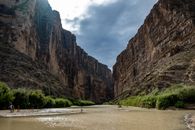
The setting matters. Big Bend National Park shares 118 miles of border with Mexico, and the National Park Service describes that boundary as part of a larger ecosystem whose political division does not erase its environmental connections. The park includes desert, mountain and river environments, as well as cultural and historic resources shaped by movement across the region.
The government says the project is narrower than some opponents have suggested. In its Supreme Court filing, DHS said no barrier construction is planned inside Big Bend Ranch State Park, that the planned work inside Big Bend National Park involves roads and approximately 17 miles of non-contiguous vehicle barriers, and that it does not intend to build a 30-foot pedestrian wall in either park.
Those representations are important, but they remain representations by the government. They are not a substitute for a complete, independently reviewable public record showing the final construction footprint, access routes, project schedules, biological surveys, cultural-resource assessments, water impacts and mitigation plans.
The government also argues that the Big Bend Sector is an area of significant illegal entry and drug activity and that leaving gaps in border infrastructure could redirect crossings and smuggling into the region. Those are legitimate security claims for an administration to make. But apprehension and seizure figures alone do not establish that a physical barrier is the most effective response, or that its benefits will exceed its financial and environmental costs.
Nor should skepticism about the project be confused with a conclusion that no border-security measure is justified. The institutional issue is narrower and more durable: whether an agency can use a waiver provision to move from a contested assessment of need to irreversible construction before the statutory basis for that move has been fully tested.
The cost of delayed accountability
Congress deliberately made these cases difficult to litigate. Section 102 permits only claims alleging constitutional violations and denies district-court jurisdiction over other claims arising from waiver decisions. The Supreme Court’s order says the major-questions doctrine does not transform a statutory-authority challenge into a constitutional claim.
That holding may be legally defensible under the text Congress enacted. It also creates a predictable asymmetry. The executive branch can issue waivers and begin work quickly. Opponents must identify a viable legal theory within a restricted review structure. Courts then confront a project that may be further along, more expensive to stop and more difficult to undo than it was when the dispute began.
This is not a problem unique to border construction. It appears whenever government action changes public land, builds infrastructure, closes a facility or commits public funds before legal authority is settled. Edgar’s recent reporting on East Potomac has examined a related question involving public land and irreversible action, but the Big Bend case presents a distinct variation: here, Congress itself created an unusually narrow path for judicial review.
That distinction should make readers more cautious, not less. A jurisdictional ruling can determine what a court is allowed to decide without answering whether the underlying policy is wise, environmentally sound or ultimately lawful under every remaining theory.
What should happen next
The next stage of this dispute should be measured through records rather than assurances. The public should be able to see the DHS waivers, final project maps, construction contracts and modifications, land-access agreements, obligations and expenditures. It should also be able to examine biological surveys, historic-preservation materials, wildlife-movement information, water assessments and the government’s explanation of which claims remain pending.
Congressional oversight has a role as well. If lawmakers intended Section 102 to permit construction to proceed before meaningful review of statutory authority, they should be prepared to explain how agencies are expected to document environmental mitigation, property impacts, cost controls and restoration responsibilities. A waiver of legal requirements should not become a waiver of record-keeping, accountability or candor.
The Supreme Court has allowed the administration to move first. That may eventually prove to be the legally required result under the statute Congress wrote. But it does not make the timing problem disappear.
The central question is not simply whether a barrier can be built in Big Bend. It is whether government can make a disputed project increasingly difficult to reverse before the courts have decided whether the government was entitled to build it. A legal system that answers only after the landscape has changed may still provide a judgment. It may provide much less of a remedy.