On November 15, twelve two-person teams will arrive in Emory, Texas, for the Major League Fishing Starlink Team Series Challenge Cup. They will bring rods, tackle, safety equipment and enough confidence to compete in front of cameras.
They will not know where they are fishing.
All fishable waters within 60 miles of Emory are off limits to competitors before the event. Each day’s competition water remains secret until the teams reach the boat ramp, where officials direct them to the launch site. The six-day event is scheduled for November 15 through November 20, 2026, and will be hosted by Rains County.
That sounds like a television gimmick. It is also a serious test of field competence.
A local angler can spend days studying a lake, graphing likely areas, checking access points and building a plan around familiar structure. These competitors have to prepare for a region, a season and a general kind of fishery without preparing for one exact creek arm, timber field or shoreline. The format removes some value from detailed pre-fishing and puts more weight on adaptability, communication, navigation and the ability to make a useful decision with incomplete information.
The secret water changes the job
Major League Fishing describes the event as live competition, and viewers will see the usual visible evidence: casts, catches, weights and leaderboard changes. The harder work begins before the first cast.
The anglers must organize a flexible plan that can survive an immediate change in water type. They need to recognize what the season and weather are likely to be doing, then adjust when the actual water offers something different. Knowing a fishery is not the same as knowing the region, and knowing the region is not the same as knowing the exact water under the boat that morning.
That distinction matters outside professional competition, too. A fishing forecast, lake reputation or past success can help a person prepare. None of them removes the obligation to read the water that is actually in front of him.
The event is built around that uncertainty. The Major League Fishing event announcement says the twelve teams will compete over six days for part of the Starlink Team Series’ combined $560,000 prize pool. The money is visible. The competence required to remain competitive when the plan changes is easier to miss.
The boat is a workplace
MLF supplies the competition boats. That does not mean the boat becomes a private workspace arranged exactly to each angler’s habits.
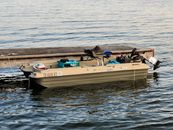
Two competitors share the boat with an MLF official, scoring and communications equipment, safety gear and a camera operator. Tackle has to be organized so that it can be found, changed and stowed without creating a delay, a tangle or an unsafe movement in a crowded working area.
A supplied boat also changes the relationship between equipment and performance. A competitor may own an excellent setup at home. In the event boat, the useful question is whether he can operate efficiently inside a space shared with another angler and several people performing official or media duties.
The team itself has to function as one operating unit. The anglers must decide when to stay, when to move, how much water to cover and whether one person should continue a productive method while the other experiments. Two people independently fishing their own tournaments will waste time. The strongest teams will be able to disagree without turning the disagreement into a second problem.
Every fish enters a procedure
In ordinary fishing, a bass is caught, admired and released. In this competition, a scorable fish enters a chain of official actions.
The MLF official weighs and records the catch, enters it into the SCORETRACKER system, announces the updated standings and manages the applicable penalty clock. The fish is released after the official process is complete, except in limited circumstances involving documentation or an exceptional catch.
The 2026 Starlink Team Series rules make clear that the official is not a passive observer. The official is the scorekeeper, rule enforcer and communications link to tournament headquarters. The anglers must fish while being watched, recorded and interrupted by procedures that can cost time if handled poorly.
That changes the meaning of a successful catch. The bass must be landed, handled correctly, weighed, recorded and released under the rules. A dramatic fish can still become a bad result if the team mishandles the seconds afterward.
Penalties cover conduct that may seem minor on television: casting before “Lines In,” unsafe boat operation, failing to connect the engine shutoff device, improper fish handling or interfering with another angler’s line. Some violations stop both anglers from fishing. In a six-day event, small losses accumulate quickly.
When connectivity becomes part of the playing field
The most modern piece of the boat is not necessarily the most glamorous. It is the scoring and communications system.
SCORETRACKER gives viewers a running account of the competition and provides the anglers with standings and official timing. But it also creates an operating dependency. Under the rules, a team cannot knowingly remain in an area without SCORETRACKER connectivity for more than 15 consecutive minutes. After that period, the team must stop fishing and return to an area where the system works. A bass caught after the permitted connectivity period is not scorable.
That means communications infrastructure is not merely a broadcast convenience. It can determine where the boat is allowed to remain and whether a catch counts.
This is a different technology question from whether a better sonar screen helps an angler find fish. The issue here is infrastructure: what happens when the scoring network becomes part of the rules and the network fails? A competitor may have found productive water and still have to leave it because the system cannot verify the contest.
Lake Fork is more than a backdrop
The event is taking place in a fishery with its own reputation and its own physical hazards. Texas Parks and Wildlife describes Lake Fork as a 27,264-acre reservoir containing submerged timber, aquatic vegetation, boat lanes, docks, points and artificial habitat structures. The agency also warns that submerged timber presents a boating hazard.
TPWD reports that more than 65 percent of Texas’s 50 largest bass, including the state record, were caught from Lake Fork. A state fisheries report estimated that the reservoir contributes approximately $40 million annually to the surrounding economy, including roughly $8 million to $10 million in direct fishing-related spending. Those are agency estimates, not an audited projection of what this tournament will produce.
That distinction is important. Lake Fork already supports a fishing economy. The Challenge Cup may add hotel stays, restaurant visits, fuel sales, guide activity and retail business, but the public record does not yet establish the event’s attendance, local spending, public cost or net economic benefit.
The reservoir is also a heavily managed and heavily fished system. TPWD has identified largemouth bass as its dominant sport fish and estimated directed bass effort at 18.4 angling hours per acre. The agency’s management work includes monitoring abundance, size structure, body condition, growth and prey species.
A tournament result cannot determine whether a fishery is healthy or under stress. The useful questions come afterward: how many fish were caught, what the catch rate was, how fish were handled, whether mortality concerns arose and whether MLF shares catch and effort information with TPWD.
Preparation is what remains when certainty is removed
The public will see a professional angler make a cast into water selected that morning. That cast is the visible end of a much longer process.
The real competition involves preparing for an unknown destination, working in a crowded boat, communicating with a teammate, navigating safely, following a detailed procedure, protecting the fish and recovering from a poor decision without making the next one worse.
A large bass may decide one moment. A six-day team event is more likely to reward repeatable execution.
The secret-water format does not prove that one tournament system is fairer or better than every other format. It does show what happens when local familiarity is deliberately limited. The anglers cannot rely on having already solved the lake. They have to solve the conditions in front of them, with another person beside them and an official keeping time.
That is not a gear demonstration. It is a controlled field operation.
A fishing tournament can hide the water. It cannot hide whether the competitors know how to work.