Diesel prices are changing the economics of freight, but not in a way that makes the transportation problem disappear.
The national average price for on-highway diesel reached $6.276 per gallon for the week of October 19, after reaching $6.529 on September 21, according to the Energy Information Administration’s weekly price data. U.S. distillate inventories were 104.3 million barrels on October 16, according to the EIA, and the agency expects diesel prices to remain above $6 during October.
That makes rail more attractive relative to long-haul trucking. It does not mean that every shipper can switch modes, that rail service is suddenly cheap, or that consumers will automatically see lower prices.
The immediate financial shift is toward companies with fuel efficiency, network scale and enough infrastructure to offer an alternative. Railroads are positioned to gain customers and bargaining power. Independent truckers and small fleets are still paying the bill first.
Railroads are showing strength, but the accounting matters
Recent railroad earnings demonstrate that demand and revenue are holding up. Union Pacific reported third-quarter 2026 net income of $2.1 billion, up 16 percent, while revenue carloads grew 6 percent. The company reported operating revenue of $7.2 billion, but said higher fuel-surcharge revenue, volume growth, pricing and other revenue all contributed to the increase. Higher fuel prices also worsened its reported operating ratio by 140 basis points.
Norfolk Southern reported record quarterly revenue of $3.5 billion, up 14 percent, on a 3 percent volume increase. Eight percentage points of its revenue growth came from fuel surcharges. Its operating ratio worsened to 67.4 percent from 64.6 percent a year earlier, showing why higher revenue should not be confused with unrestricted profit growth.
CSX reported third-quarter revenue of $4.02 billion, up 12 percent, with total volume up 5 percent and intermodal volume up 7 percent. The company attributed the revenue increase to fuel-surcharge revenue, higher volume and pricing across its businesses.
Those results support a stronger rail position. They do not prove that railroads are capturing the entire benefit of the diesel shock. A fuel surcharge may reimburse a railroad for higher fuel costs rather than create a pure profit increase. Additional volume may also require more labor, equipment, terminal capacity and capital spending.
The relevant comparison is not cheap rail. It is expensive trucking.
The financial calculation facing a shipper is relative. Rail can become more attractive even while its own fuel, labor and service costs rise, provided trucking becomes more expensive or less dependable at the same time.
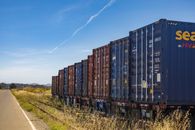
The Association of American Railroads says freight rail moves one ton of cargo nearly 500 miles per gallon and is roughly three to four times more fuel-efficient than trucks. That is an industry-source estimate, but the underlying advantage is well established: a train can move large volumes over long distances with less fuel per ton than a truck fleet.
For a manufacturer or retailer, the question is therefore not whether rail has become inexpensive in absolute terms. It is whether rail has become less expensive than the available trucking alternative after fuel surcharges, labor, handling, inventory and delivery costs are included.
That calculation favors rail most clearly for predictable, long-distance freight that can tolerate scheduled transit and has access to intermodal terminals. It is much less decisive for short-haul shipments, urgent deliveries, temperature-sensitive products or businesses located far from rail infrastructure.
Why the economy cannot simply switch freight modes
Transportation networks are built around contracts, terminals and delivery promises. A shipper may prefer rail on a spreadsheet and still remain with trucking because a missed production schedule, stockout or late retail delivery costs more than the freight savings.
Moving a container from truck to rail can add terminal handling, drayage and inventory requirements. A company may need more warehouse space or a larger safety stock because rail transit is slower or less flexible. Those are real costs, even when the line-haul rate is lower.
Capacity is another constraint. Railroads must decide how much intermodal business they can accept, which freight receives priority and whether new customers are worth the effect on service reliability. If demand rises quickly, terminals, containers, train slots, sidings, ports and last-mile trucking can become the next bottlenecks.
Rail’s fuel advantage is therefore an opportunity, not a universal substitute. The economy has no single freight market in which every shipment can be assigned to the cheapest mode.
Who benefits from the fuel shock
Freight railroads are the clearest beneficiaries. They may gain intermodal volume, fuel-surcharge revenue, new customers and greater negotiating leverage. A temporary shift is useful; a customer that redesigns its distribution network around rail is more valuable.
Large shippers with flexible distribution systems may also benefit. They have the volume, logistics staff and bargaining power to compare modes, negotiate contracts and absorb the transition costs.
Ports, inland terminals and intermodal equipment providers may gain if more containers move through rail-connected facilities. Rail-served agricultural and manufacturing regions may receive some protection from higher truck rates.
The benefits for small businesses are less certain. A small firm may want rail’s lower line-haul cost but lack the shipment volume, terminal access or logistics expertise to use intermodal service efficiently. In that case, the business remains exposed to trucking prices even while larger competitors gain another transportation option.
Who bears the cost
Independent truckers and small fleets face the most immediate pressure. Fuel is purchased weekly, while payment for a completed load may arrive later. A carrier may have a fuel surcharge in its contract, but the adjustment may lag the cost increase or fail to cover every expense.
Large carriers generally have more tools: fuel programs, diversified routes, stronger borrowing capacity and greater negotiating leverage. Smaller operators may respond by reducing routes, deferring equipment purchases, accepting less favorable loads or borrowing to cover working capital.
Shippers without rail access have fewer choices. They may pay higher trucking rates or absorb longer delivery costs elsewhere in the supply chain. Manufacturers and retailers that do shift freight to rail may face additional inventory and warehousing expenses.
Consumers can bear part of the cost through higher prices for food, construction materials, household goods and other freight-intensive products. Even if rail prevents an additional increase in transportation expense, that protection may never appear as a lower shelf price.
The next test is what happens when diesel prices fall
The latest railroad numbers show that rail is gaining relative strength during a fuel shock. They do not yet prove a permanent migration from truck to train.
If diesel prices decline, some shippers may return to trucking. The more important test will be whether railroads retain customers after the immediate price difference narrows. That will depend on service reliability, transit times, contracts and whether companies have already redesigned their distribution networks.
There is also a competition question. If shippers have limited alternatives, a fuel shock that improves rail’s position may give railroads more leverage over rates and service terms. Greater efficiency is not the same as unlimited pricing power.
The broader financial lesson is familiar: energy shocks reward organizations with scale, alternative networks, capital and time. They punish companies that must buy fuel today, operate on thin margins and collect revenue later.
Railroads are not rescuing the economy from high diesel prices. They are benefiting from being less exposed to the same cost than their main substitute. The likely result is a more segmented freight market: rail handling more long-haul and predictable cargo, large trucking companies preserving service through scale and surcharges, and small fleets carrying the greatest working-capital risk.
That may limit the damage from the fuel shock. It will not make the shock disappear.