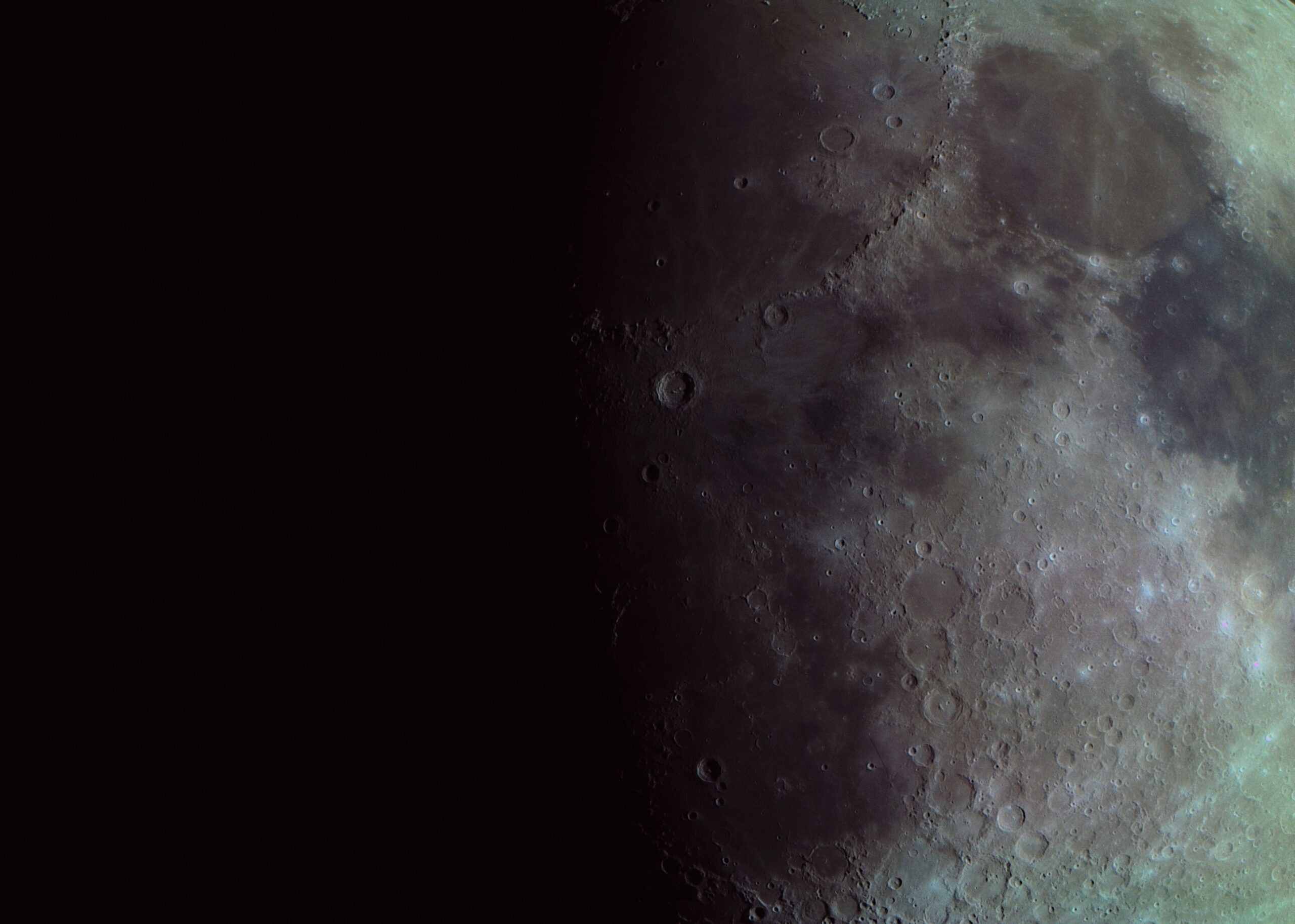
The Moon is covered with craters, but scientists rarely have the opportunity to study one soon after it forms. McGetchin crater offers that opportunity—and its most important feature may not be the crater itself.
Identified in images from NASA’s Lunar Reconnaissance Orbiter, McGetchin is an approximately 222-meter-wide impact scar that formed sometime between April 11 and May 22, 2024. Researchers estimate that an impact of this size occurs on the Moon about once every 130 years. (NASA)
The crater is scientifically valuable because the surrounding surface still preserves evidence of what the impact did to the Moon’s soil. That evidence is normally obscured by time and subsequent impacts.
A crater found by comparing the Moon with itself
McGetchin was discovered during a routine comparison of repeated Lunar Reconnaissance Orbiter images. Robert Wagner, an image-processing specialist working with the Lunar Reconnaissance Orbiter Camera system, identified an unusually bright feature surrounded by a darker halo. The pattern suggested that loose surface material had been thrown outward by a recent impact.
Researchers compared images taken before and after the suspected event and then examined higher-resolution observations from the orbiter’s Narrow-Angle Camera. They identified a crater approximately 222 meters across and about 43 meters deep. (NASA)
The chronology is important. Scientists did not observe the impact as it happened. They inferred its timing because the crater was absent from earlier images and present in later ones. The result is therefore a date range, not an exact timestamp.
That is a strong conclusion, but it remains a reconstruction from before-and-after evidence.
The object that produced the crater was not directly observed on its approach. NASA describes it as possibly comparable in size to a three- to six-story building, while a NASA Astronomy Picture of the Day estimate gives a smaller range of roughly 10 to 20 meters. Those estimates depend on assumptions about density, speed, composition and impact angle. (NASA)
The crater’s dimensions are measured. The projectile’s precise size is inferred. The distinction matters.
The ground around the crater is the more revealing discovery
The most significant finding concerns what happened beyond the crater’s rim.
A second study examined thermal measurements from Diviner, an instrument aboard the Lunar Reconnaissance Orbiter. Researchers found a cold region extending roughly seven kilometers around McGetchin. During the lunar night, the area was approximately eight to nine kelvin—about 14 to 16 degrees Fahrenheit—cooler than the surrounding terrain. (PubMed)
The explanation involves the Moon’s regolith, the loose layer of dust, soil and broken rock covering much of the surface.
An impact does not simply excavate a bowl. It also shakes, fractures and redistributes the material around it. At McGetchin, the impact appears to have loosened or “decompacted” the upper layers of regolith across a much wider area than the crater itself.
Looser material contains more empty space. That changes how efficiently the surface stores heat. During the long lunar night, the disturbed area cools more rapidly than its surroundings, producing the thermal signature detected by Diviner.
The study’s authors examined newly formed lunar craters larger than 20 meters and found that craters above roughly 30 meters generally produce detectable cold spots. The size of the thermal anomaly also increases with crater diameter, suggesting that larger impacts disturb the shallow subsurface more deeply. (PubMed)
McGetchin is therefore more than a new crater. It is a natural experiment in lunar surface mechanics.
Why the disturbed ground matters for future missions
The Moon has no substantial atmosphere to burn up small incoming objects. Impacts are consequently part of the ordinary lunar environment, even though an event as large as McGetchin is rare.
NASA says the Lunar Reconnaissance Orbiter has identified at least 1,000 new impact craters during its mission and documented many additional surface changes associated with impacts and ejecta. Smaller impacts occur much more frequently than McGetchin-sized events. (NASA)
For spacecraft and future surface missions, the issue is not only the probability of a large impact. It is also the condition of the terrain.
Rovers and landers interact mechanically with regolith. Wheel traction, sinking, braking and energy use depend on whether the soil is compact, loose, rocky or disturbed. A surface change extending kilometers from a crater could therefore matter to mission planning even when a vehicle never approaches the crater itself.
The altered ground could affect how rover wheels interact with the surface. That remains an engineering implication rather than a demonstrated failure mode: no rover has been shown to have encountered McGetchin’s disturbed terrain. The mechanism is physically plausible, however, and the new observations provide a way to test it. (NASA)
The finding may also affect how scientists interpret thermal observations elsewhere on the Moon. A cold patch is not necessarily evidence of an unusual composition or a permanent geological difference. It may instead be the aftereffect of a relatively recent impact that loosened the surface.
A lesson in planetary timescales
The Moon is sometimes described as geologically inactive because it lacks Earth’s atmosphere, oceans, vegetation and plate tectonics. That description is incomplete.
The lunar surface changes through impacts, seismic activity, temperature-driven breakdown and the gradual movement of dust. These processes are usually slow from a human perspective, but McGetchin provides an unusually clear timestamp and a fresh disturbance to study.
The crater formed in 2024, was discovered in 2025 and was analyzed in detail in 2026. That sequence was possible because the Lunar Reconnaissance Orbiter has repeatedly surveyed the Moon for more than 17 years. A single image would show a crater. Repeated images show change. (NASA)
The rare impact is useful because it is part of a much larger monitoring program. The science depends on older images, new images, thermal data, topographic measurements and impact models working together.
The impact itself was accidental. The discovery was not.
What scientists know—and what remains uncertain
Researchers know that a new crater approximately 222 meters wide formed on the Moon between April 11 and May 22, 2024. They know that it is the largest newly formed crater identified during the Lunar Reconnaissance Orbiter mission and, according to NASA, the largest newly formed crater yet found in the solar system.
They also know that thermal measurements show a broad, cooler region around the crater, consistent with impact-driven disturbance and loosening of the lunar regolith. (NASA)
They do not know the exact size, composition or trajectory of the impacting object. They do not yet know how quickly the cold spot will fade, whether the relationship between crater size and thermal disturbance applies uniformly across different lunar terrains, or precisely how much the altered soil would affect a rover’s movement.
Those questions do not make the discovery inconclusive. They are the next questions made possible by a well-documented event.
McGetchin crater is a rare opportunity to observe the Moon changing on a human timescale. Its importance lies less in the violence of the collision than in the evidence left behind: a measurable disturbance extending far beyond the visible scar.
The crater is the event. The loosened ground around it is the record.