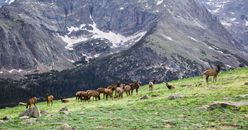
A hunter can have a license, a legal season and a constitutional right to hunt—and still be standing below a locked gate, watching an empty drainage or looking at a river too warm to fish.
That is the practical question Colorado voters should keep in mind as they consider Amendment 83 in the November 3, 2026, election.
The proposed amendment would add a constitutional right to hunt, fish and harvest state-managed fish and wildlife by “traditional methods.” It would also declare hunting and fishing the preferred means of responsibly managing those populations. The measure requires 55 percent approval because it would amend the state constitution.
Supporters describe Amendment 83 as a safeguard against future efforts to prohibit or sharply restrict hunting and fishing. Opponents say those activities are already legal and regulated, and that constitutional language could make it harder for wildlife managers to respond when disease, habitat, public safety or changing biological conditions require a different decision.
The strongest practical argument is simpler than either campaign slogan: a constitutional right may protect an opportunity, but it cannot guarantee a successful hunt.
What the amendment would—and would not—do
Colorado’s 2026 State Ballot Information Booklet says the amendment would not immediately change existing hunting or fishing regulations. Licenses, permits, seasons, locations, methods, bag limits and other rules would remain in place.
The measure also says it does not authorize trespass or change private-property law. It would not open a locked gate, create an easement, guarantee an elk tag or require a landowner to provide access to a river or mountain pasture.
The proposed constitutional language preserves the authority of the Colorado Parks and Wildlife Commission and the General Assembly to regulate hunting, fishing and wildlife management. But those regulations would have to be “reasonable and necessary” for sound scientific conservation and management, public safety or preserving future hunting and fishing opportunities statewide.
That wording is where the future arguments begin.
“Traditional methods,” “preferred means” and “necessary” are not defined with the precision of a season date or a bag limit. The state’s official analysis warns that undefined language could lead to legal challenges involving existing or future regulations. Colorado Parks and Wildlife could face additional legal and administrative work even if there is no immediate change in the field.
The right does not create more wildlife
Elk do not read constitutions. Neither do trout.
A constitutional provision cannot reverse a poor recruitment year, restore damaged habitat, eliminate drought or make a disease outbreak disappear. If a herd is below a sustainable level, managers still have to control harvest if they want animals available in the future. If a stream is too warm or too shallow, a fishing closure may be necessary even when anglers would prefer the season to remain open.
That is not an attack on hunting or fishing. It is the basic bargain that makes regulated outdoor opportunity possible.
In my recent reporting on South Dakota deer disease, the important point was that a license is permission to participate under the biological information available at the time—not a promise that the herd will remain healthy or that the rules will never change. The same principle applies here. A constitutional right may make some restrictions more difficult to defend, but it cannot make an unhealthy population ready for harvest.
Colorado’s official ballot analysis says license sales provide about one-third of CPW’s current annual revenue, approximately $115 million. That makes hunters and anglers more than users of the system. They are also among the people financing wildlife management. But paying into the system does not mean purchasing a guaranteed result. It means supporting the work required to keep future opportunity possible.
Access is still a physical problem
Amendment 83 also arrives after a series of public arguments about access. But this is not another general access story.
Federal policy can open a gate without manufacturing a hunt. Roads still wash out. Boat ramps still close. Private inholdings still interrupt public parcels. Parking fills. Cell service disappears. Wildlife officers remain limited. A legal opportunity can remain unusable for anyone who cannot safely reach the ground, afford the trip or find room among the crowd.
Amendment 83 does not solve any of those problems. It creates a legal foundation beneath hunting and fishing. The physical conditions remain exactly where they were: in the weather, the water, the habitat and the maintenance budget.
“Traditional methods” could become a court question
Existing wildlife rules regulate weapons, bait, traps, dogs, electronic devices, seasons, boundaries and other methods. Most hunters understand that regulations are part of the deal. The question is whether a future restriction would be treated as an ordinary management decision or as an unacceptable burden on a constitutional right.
That distinction could matter during a disease response, a safety closure or a dispute over a particular method of take. It could also matter when wildlife managers have to act before every biological question is settled.
Field management rarely arrives with perfect information. A commission may need to reduce a quota, close a season or change a boundary while the evidence is still developing. If each decision must also survive a constitutional challenge over whether it was “necessary,” the state may spend more time proving the legal sufficiency of a decision and less time adjusting quickly to conditions on the ground.
That is an inference, not an established result. The official fiscal analysis does not estimate a specific cost because future litigation is unknowable. But the possibility of additional legal expense is not theoretical. It is written into the state’s own analysis of the measure.
The elk still set the terms
Colorado voters are being asked whether hunting and fishing deserve a stronger legal position. That is a legitimate political question. So is whether wildlife management should be placed partly inside constitutional litigation.
For people who actually hunt and fish, the useful test is what happens after the vote. Can CPW still reduce a quota after a poor reproduction year? Can it close a fishery during dangerous low flows or high water temperatures? Can it restrict a method for public safety? Can it respond to disease without first defending every decision against a new constitutional claim?
Those questions will not be answered on the first morning of the next season. Existing rules would remain in place. The longer test would come through rulemaking, legal challenges and the cost of defending decisions that wildlife managers previously handled through statutes, commission regulations and biological evidence.
As I wrote after Pennsylvania added an early firearms elk season, adding days to a calendar does not create more elk or guarantee usable access. The same lesson applies here in a different form. Adding a right to the constitution does not create animals, water, habitat, roads or room on the mountain.
A right to hunt can protect hunters from some political decisions. It cannot protect them from drought, disease, bad habitat, a closed road or an empty drainage. Those problems still have to be handled the old way: with evidence, preparation, maintenance and people who know what they are looking at.