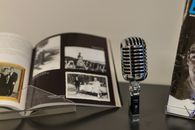
There is something almost comically modest about the Smithsonian’s new Good Mythical Morning display: a desk microphone and two blindfolds.
They are small objects, easy to overlook. They do not resemble the grand artifacts that traditionally announce historical importance. No presidential desk, dazzling costume or famous instrument is required to understand their symbolic weight. These are props from a YouTube program in which Rhett McLaughlin and Link Neal have spent more than a decade tasting improbable foods, testing products, playing games and turning routine into a form of entertainment.
The National Museum of American History is scheduled to place the objects on display on October 22, 2026, outside its Entertainment Nation exhibition. The museum announced the acquisition in 2024, describing the microphone and blindfolds as part of its entertainment collections. Its collection record for one of the blindfolds identifies the object as a recurring part of the show’s taste-test format and places it within the history of popular entertainment and social media.
The Smithsonian is right to recognize Good Mythical Morning as part of American entertainment history. The more difficult question begins after acquisition.
What, exactly, is the museum preserving?
The object is not the whole performance
A microphone can establish that a program was made. A blindfold can identify one of its recurring rituals. Neither object, by itself, explains the peculiar achievement of Good Mythical Morning: its weekday rhythm, its accumulated host chemistry, its writers and producers, its carefully calibrated mixture of repetition and surprise, or the audience that learned to treat the show as part of the day.
The program began in 2012 as a comparatively informal web series and developed into the flagship of Mythical, a substantial creator-led entertainment company. The Smithsonian’s acquisition announcement describes the series’ scale: thousands of episodes, billions of views and a production history built around trivia, taste tests, challenges, product experiments and guests. YouTube’s own account of Mythical likewise presents the company as an internet-first studio rather than merely a pair of personalities operating a camera.
That distinction matters. The historical object is not simply the microphone. It is a production system.
It includes the people who wrote the prompts, staged the games, designed the set, edited the episodes, negotiated sponsorships, monitored audience response and maintained the daily machinery that made informality look effortless. It includes the viewers whose comments, habits and shared references helped convert a recurring program into a social ritual. It includes YouTube itself, whose recommendation systems, advertising structures, interfaces and policies helped determine what the show could become.
The microphone is therefore best understood as a doorway. It should lead visitors toward the invisible labor and infrastructure surrounding it, rather than standing in for them.
Television was never just a television set
Museums have long understood that entertainment objects carry more than celebrity associations. A costume can preserve a performance language. A guitar can document a musician’s public identity. A prop can reveal how a fictional world was built.
Arthur’s recent writing on Bob Mackie and the authorship of costume made a related argument: the visible object is not ornamental evidence placed around the “real” performance. It is part of how the performance means what it means. The Smithsonian’s Good Mythical Morning display presents a similar opportunity, but with an additional complication. The show’s defining form is not only visual. It is procedural.
The pleasure lies in recurrence. Two hosts sit beside one another. A familiar format is introduced. The rules are explained. Something disgusting, absurd or unexpectedly funny enters the frame. The audience recognizes the structure even as it waits to see how the structure will be disturbed.
This is closer to a daily variety program than to a single collectible object. Its history lives in timing, editing, ritual and relationship. A blindfold has meaning because viewers know what usually happens after it appears—and because the hosts have spent years making a recognizable format feel temporarily unpredictable.
The museum’s challenge is to preserve that form without pretending that a few props can contain it.
YouTube is not a neutral archive
The problem becomes more urgent because the program’s historical life is tied to a commercial platform.
YouTube is where many viewers encountered Good Mythical Morning. It is also a company whose interface, recommendation systems, monetization rules, licensing arrangements and preservation practices can change. A video may remain technically available while becoming harder to find. A thumbnail may change. Comments may disappear. An episode may be edited, restricted, demonetized or removed. The surrounding platform may look familiar while altering the conditions under which the work is experienced.
Research by the Victoria and Albert Museum and its partners on born-digital and hybrid objects emphasizes that digital preservation involves more than saving a file. Institutions may also need to document the software, interfaces, platforms and social circumstances that give the file meaning. Scholarship on YouTube preservation makes the related point that the platform should not be confused with a permanent public archive.
For the Smithsonian, that means preserving more than episodes wherever rights and resources permit. It may mean retaining scripts, production documents, episode metadata, promotional materials, set information, audience responses and records of how the program was distributed. It may mean documenting what changed over time, including episodes that were deleted or altered.
None of this requires the museum to preserve every comment or every piece of platform data forever. It does require the institution to explain what it believes future researchers will need in order to understand the show as a working cultural form.
The museum is collecting a living subject
There is another complication. Good Mythical Morning is not a completed historical artifact. It remains part of an active business and an ongoing relationship between creators and viewers.
Museums often prefer cultural subjects after their meaning has settled. A completed career is easier to summarize. A deceased performer cannot object to a label. A closed studio does not need to negotiate what institutional memory will reveal.
Digital culture does not offer that convenience. The Smithsonian is collecting a living program while its business model, audience and cultural meaning continue to change. That is not a flaw. Waiting for internet culture to become safely historical would guarantee that much of its evidence vanished before anyone began collecting it.
But early recognition creates a risk of simplification. A still-functioning creator enterprise may be transformed into a tidy story about entrepreneurial personalities who “changed media,” while the platform dependence, commercial negotiations and collective labor fade into the background.
The museum should resist the temptation to turn a complicated production history into an inspirational origin story. The history of creator culture is not only the history of successful creators. It is also the history of editors, moderators, freelancers, fan communities, regional networks and small channels that never became profitable enough to attract national recognition.
Who gets preserved as the internet?
National museums naturally collect what is visible, stable and legible. Rhett and Link are valuable subjects partly because their work has already achieved the scale and durability that institutions know how to describe.
That makes Good Mythical Morning an appropriate acquisition. It also makes the acquisition incomplete as a portrait of internet culture.
If museums preserve only the most successful channels, they risk confusing the winners of the creator economy with the history of the internet itself. Much online culture remains local, amateur, marginal, ephemeral or commercially inconvenient. Fan-made archives, regional communities, independent moderators and failed experiments may tell future researchers as much about digital life as the largest channels do.
This is where the Smithsonian’s authority becomes both useful and dangerous. A national collection can give legitimacy to a form of entertainment once dismissed as disposable. It can also certify one polished version of that form as representative.
Arthur’s recent examination of the Lucas Museum’s attempt to take popular images seriously made the necessary distinction: accessibility is not the same as ease, and popularity is not proof of artistic significance. The same principle applies here. The Smithsonian need not defend Good Mythical Morning as “important” merely because millions of people watched it. It should explain what the program reveals about American entertainment, labor, technology and social life.
That is a stronger argument than celebrity recognition.
A useful obligation
The Smithsonian has not made a mistake by collecting a microphone and two blindfolds. On the contrary, the objects are useful precisely because they are insufficient.
They make visible a historical problem that museums can no longer postpone. Culture increasingly arrives through platforms, routines, communities and businesses rather than through a finished object with a stable owner and a convenient display case.
The microphone should tell visitors that Good Mythical Morning existed. The blindfold should recall the show’s recurring games and its peculiar material charm. But the display should also invite harder questions: Who made the program? What did the audience contribute? How did YouTube shape its visibility? Which records will survive if the platform changes? What parts of the show’s labor remain invisible because they were never treated as collectible?
If the objects point toward those questions, the Smithsonian will have done more than honor two popular hosts. It will have begun to preserve creator culture as a system of work, attention and participation.
If they merely reassure visitors that famous internet personalities now belong beside the established icons of entertainment, the display will be a charming certificate of arrival.
The Smithsonian has collected the props. Now it must show that it understands the performance.