When a museum presents a living tradition, it is tempting to describe the event as an act of preservation. The word is reassuring. It suggests that something valuable has been rescued from disappearance and placed somewhere safe.
But preservation is not always the same as continuity. A museum can preserve costumes, objects, photographs and fragments of repertory. It cannot preserve a performance tradition merely by placing its materials inside a contemporary-art institution. The tradition exists in bodies, voices, apprenticeship, translation, rehearsal, memory and the repeated encounter between performers and audiences.
That is the more difficult question raised by Alison Kuo’s A flame latches to a bit of straw, commissioned by New York’s New Museum as the culmination of the artist’s residency. The work will be performed from October 22 through October 24, 2026, beginning tomorrow. It draws on Cantonese opera, Kuo’s family history, migration, Chinatown material culture and the experience of discovering an inheritance that was practiced by earlier generations but not transmitted to her in complete or uncomplicated form.
The performance brings professional Cantonese-opera performers together with local musicians, artist-collaborators, sculptural sets and costumes made in the museum’s studio from materials sourced around Manhattan’s Chinatown. It incorporates material from Unfinished Love and Hatred in the Phoenix Pavilion and concludes with a Cantonese translation of “We’ll Meet Again,” the English song associated with Vera Lynn. The New Museum describes the work as addressing migration, political upheaval, loss, translation and reunion.
That description contains the work’s promise and its danger. Migration and loss can be treated as serious historical subjects, or they can be arranged into a beautiful emotional atmosphere in which hardship becomes another material for contemporary art. The performance will have to negotiate that distinction in public, where its success cannot be determined by the generosity of its intentions alone.
The museum is not discovering Cantonese opera
Cantonese opera, also known as Yueju opera, is not a newly discovered resource for American culture. The tradition has developed across roughly four centuries and has moved among Guangdong, Guangxi, Hong Kong, Macao and overseas Chinese communities. UNESCO’s account of Yueju opera emphasizes transmission through drama schools and apprenticeship systems among Cantonese-speaking communities. Its designation as intangible cultural heritage recognizes a living system of practice, not merely a collection of attractive objects.
Nor did Cantonese opera arrive in the United States with a downtown art museum. The Museum of Chinese in America’s records of Chinese musical and theatrical associations document the form’s substantial presence in North American Chinatowns, including a particularly active period during the 1920s and 1930s. Performers, associations, theaters and community networks sustained the tradition long before contemporary museums began presenting it as evidence of institutional diversity.
What is new, then, is not the existence of Cantonese opera in American cultural life. It is the institutional framing. A contemporary art museum is treating the form as material for an artist-led performance rather than presenting it only as heritage. It is placing professional practitioners alongside visual artists and friends. It is using Chinatown not simply as a historical reference but as a material environment. And it is making translation part of the work rather than treating language as a problem that must be removed before culture can be understood.
The New Museum should receive credit for recognizing that inheritance is often partial. Kuo is not claiming to offer a complete or untouched version of Cantonese opera. She is staging a process of encounter: what it means to approach a family tradition through fragments, professional expertise, archival distance and contemporary artistic form.
Authenticity is the wrong first question
There is a familiar trap in writing about artists who work across traditions. The artist is asked whether the work is “authentic,” as if culture were a sealed container and every alteration were a form of damage.
That is too crude a standard. Cantonese opera has traveled, adapted and absorbed changing audiences, technologies and social conditions. Diaspora does not automatically weaken a tradition. It is one of the places where traditions live.
The more useful question is authority. Who is permitted to reinterpret a tradition? Who is treated as a custodian, who as a collaborator and who merely as source material? What knowledge belongs to the artist, what knowledge belongs to the professional performers and what knowledge belongs to the communities that have sustained the form outside the museum?
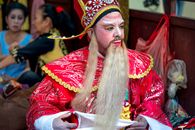
Kuo’s use of professional performers matters because it makes expertise visible. This is not simply a visual artist borrowing a vocabulary of elaborate costume, stylized movement and vocal ornament. The performance creates a public meeting between the contemporary art world and a tradition whose knowledge is embodied elsewhere.
That meeting may be productive. It may also be unequal. Museums possess money, publicity, archival resources and the power to define what counts as culturally significant. Community practitioners may possess the knowledge without possessing comparable institutional authority. A generous collaboration can still occur within an uneven structure.
A performance cannot be preserved as a still life
Recent museum culture has become increasingly interested in living practices. Lowriding, creator-led entertainment and popular visual culture are all being brought into institutions that once preferred objects with more conventional claims to artistic seriousness.
Cantonese opera presents a particularly demanding case because its meaning depends on so many forms of continuity at once: language, vocal technique, musical accompaniment, gesture, stylized movement, costume, makeup, repertory, apprenticeship and audience recognition.
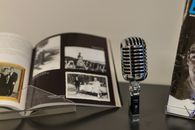
A museum can preserve a costume. It can document a score, collect photographs and record an interview. Those things matter. But the costume is not the performance, just as a lowrider behind glass is not the same as a car moving through a neighborhood, and a microphone is not the same as a living online program with its labor, audience and platform conditions.
The museum’s task is therefore not to recreate an entire community inside a gallery. That would be both impossible and presumptuous. Its task is to avoid suggesting that the gallery contains the culture in full.
The strongest version of A flame latches to a bit of straw will direct audiences outward: toward performers, community organizations, language, rehearsal, local history and the continuing work required to keep a tradition alive. The weakest version will allow the museum’s vocabulary of residency, installation and material practice to become the dominant explanation for why Cantonese opera matters.
Recognition is not support
Museums are under understandable pressure to broaden their collections and demonstrate relevance to communities that were once treated primarily as subjects. Recognition can correct an old cultural hierarchy. It can provide resources, legitimacy and a new audience.
But inclusion is not the same as continuity. A temporary performance can be culturally meaningful and still leave no durable relationship behind it.
The New Museum should therefore be judged by what happens after the three scheduled performances. How were the professional performers selected and compensated? Who advised on pronunciation, repertoire, music and staging? What documentation will be preserved? Will costumes, sets, scores, rehearsal materials or oral histories remain accessible? Is there a continuing relationship with Cantonese-opera organizations after the residency ends?
These are not administrative details. They determine whether the museum has created an encounter or merely staged one.
The distinction is especially important because museums often recognize living culture at the moment when it can be translated into institutional language. A tradition becomes legible to the museum when it can be described as material practice, installation, migration narrative or contemporary reinterpretation. Those descriptions may be accurate, but they should not become the only terms through which the tradition is allowed to appear.
The museum must remain the late arrival
The best response to this performance is neither automatic celebration nor automatic suspicion. Cantonese opera does not need to be protected from change, and a museum does not become exploitative simply because it presents a tradition outside its original community setting.
But the institution should understand its own lateness. It is not granting Cantonese opera permission to matter. It is arriving after performers, associations, families and neighborhood institutions have already done the work of sustaining it.
That humility is not ceremonial. It should shape the museum’s obligations. The institution must make room for disagreement about the work. It must permit professional practitioners and community audiences to be more than evidence of the artist’s journey. It must preserve not only the objects that photograph well but the relationships and knowledge that make those objects meaningful.
A tradition remains alive not by avoiding transformation, but by allowing transformation to occur within relationships of knowledge, practice and accountability. The New Museum’s performance may become a genuine act of transmission. It may also expose the tendency of even generous institutions to recognize living culture only after translating it into forms they already know how to fund, display and discuss.
The difference will not be settled by the beauty of the costumes or the sincerity of the applause. It will be visible in who remains connected to the work when the residency ends.
A museum can borrow a tradition. It can help more people encounter it. It can preserve traces of its performance. But it cannot own the future of a form whose life depends on people continuing to practice, alter, teach and argue about it.