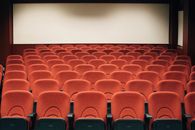
The empty auditorium is a peculiar image. It can suggest abandonment, anticipation or a kind of perfect attention: rows of seats waiting for the room to become dark.
At the Museum of the Moving Image in Astoria, New York, the exhibition Seeing the Cinema: Photographic Visions of Movie Theaters—on view from October 10, 2026, through March 21, 2027—treats that room not merely as a container for films but as an architectural and cultural form. The exhibition brings together Thomas R. Schiff’s panoramic theater exteriors, Hiroshi Sugimoto’s long-exposure auditorium photographs, John Margolies’s drive-in documentation and Joseph Holmes’s portraits of projectionists. The museum’s own description is admirably direct: these photographs consider what it has meant, and continues to mean, to gather in the dark while stories unfold on a screen.
That is a more interesting question than whether movie theaters are dying. The death-of-cinema argument has become a kind of cultural wallpaper, repeated so often that it no longer clarifies anything. The better question is what kind of public space a theater is—and what happens when that space is reduced either to a premium retail experience or to a nostalgic object.
The timing of the exhibition is telling. Theater owners are investing heavily in premium screens, upgraded sound, reclining seats, food and beverage service and other amenities. Cinema United reported more than $1.5 billion in North American theater investment during the year ending in September 2025, describing the work as a commitment to premium entertainment and the experiential economy. The supplied industry research also points to a further $1.2 billion in investment during 2026.
None of this is fraudulent. Better projection, sound, seating and accessibility matter. A comfortable theater is preferable to an uncomfortable one, just as a clean restroom is preferable to a philosophical argument about the decline of civilization. But the language of the experience economy can obscure something important: movie theaters have always sold an experience.
The great movie palaces were not bare distribution warehouses with velvet added later. They were designed as spectacles in themselves. The architecture announced that entering the theater meant entering another social world. The Library of Congress’s collection of motion-picture theaters preserves this history in images of movie palaces, neighborhood houses, drive-ins, marquees, auditoriums and ordinary moviegoing life. The theater was at once a business, a landmark, a workplace and a civic gathering place.
What has changed is not the existence of the experience but the economic vocabulary surrounding it. The old theater sold glamour, escape and collective fantasy. The new theater sells upgraded infrastructure, food, comfort and scarcity. The experience is now something to be itemized, priced and placed in a higher tier.
Again, there is nothing inherently wrong with that. The difficulty begins when amenities surrounding attention are mistaken for attention itself. A larger screen may improve a film. It does not, by itself, create an audience. A cocktail may improve an evening. It does not turn a multiplex into a cultural institution.
The theater’s deeper power has always come from the terms it imposes on the viewer. In a living room, one controls the lighting, the volume, the duration and the interruptions. In a theater, one temporarily surrenders those controls. One accepts the room’s darkness, the film’s length and the unpredictable presence of strangers. This arrangement is not morally superior to domestic viewing. The person checking a phone in the third row is evidence that public attention has never been a flawless achievement.
But it is a distinct form of attention. The theater asks people to occupy the same interval of time without necessarily knowing one another. It permits anonymity without isolation. The room is public, yet the experience can feel private. That contradiction is not an incidental feature of cinema. It is one of its social inventions.
The four photographic perspectives in Seeing the Cinema make that invention visible. The exterior presents the theater as a civic sign, a building that tells a neighborhood what kinds of gathering are possible. The auditorium presents it as an instrument for collective attention. The drive-in complicates the arrangement by combining public assembly with the privacy of the automobile. The projectionist presents the theater as labor rather than magic.
That final perspective is especially valuable. Projectionists, ushers, ticket sellers, cleaners, concession workers and managers have always been part of the machinery of cultural memory, even when audiences preferred to imagine that the film simply appeared. Joseph Holmes’s portraits remind us that cinema is not only an art of images. It is also an organization of people, equipment, maintenance and trust.
This is where independent cinemas offer a useful counterexample to the industry’s premiumization narrative. The 2026 Art House Convergence survey of more than 27,000 moviegoers at more than 50 independent cinemas found that 88 percent considered their local art house a cultural hub. The survey also reported that member-theater grosses were 38 percent above 2019 levels and that younger audiences were entering the art-house world. Cinema United’s summary of the survey provides useful evidence that at least some audiences value theaters as institutions rather than merely as delivery points for newly released products.
That distinction matters. A cultural hub depends on programming, staff knowledge, continuity and local relationships. It may host a repertory screening, a filmmaker conversation, a documentary, a children’s program, a festival or simply a dependable evening out. Its value cannot be reduced to screen size or concession revenue, though it must somehow pay the electricity bill. This is the familiar difficulty of cultural institutions: the qualities that make them valuable are often the qualities least easily captured by industry-wide investment figures.
The danger is not only that theaters may close. It is that they may survive in a narrowed form—technologically impressive, financially optimized and culturally diminished. Premium investment can strengthen exhibition while concentrating attention around franchise releases, event films and titles capable of justifying higher prices. The theater becomes more elaborate while becoming less hospitable to ordinary films, local programming and unpredictable forms of public life.
Museums introduce a different danger. They preserve what ordinary institutions have failed to sustain. A photographic exhibition about movie theaters can honor the architecture and social history of cinema while quietly revealing that moviegoing has become less central to everyday life. The theater becomes most legible as culture after it has become less available as ordinary infrastructure.
That is not an argument against preservation. On the contrary, preservation is how a culture remembers the conditions that produced its pleasures. But memory should not become a substitute for continuation. The theater should not be saved only as a photograph, an ornate facade or a carefully restored projection booth.
A theater is culturally important not because it is old, luxurious or profitable. It is important because it gives a community a place to pay attention together. The current exhibition at the Museum of the Moving Image understands that. The industry should understand it as well.
The future of cinema will not be secured by nostalgia, nor by turning every screening into a luxury package. It will depend on whether theaters can remain places where people encounter films, workers, strangers and one another under conditions that are public without becoming impersonal. The darkness, after all, was never merely a way to hide the walls. It was the thing that allowed a room full of strangers to become an audience.