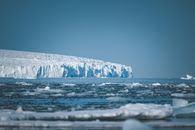
Thwaites Glacier has acquired a dramatic nickname: the “Doomsday Glacier.” The phrase is memorable, but it encourages a misleading picture of a single catastrophe waiting on a fixed timetable.
The more important development is less theatrical and more consequential. A new Nature Communications study finds that models may underestimate Thwaites Glacier’s future contribution to sea-level rise because they simplify the boundary between grounded and floating ice. Instead of treating that boundary as a sharp line, the study represents it as a dynamic grounding zone several kilometers wide, where seawater can move beneath the glacier during tidal cycles.
Under the study’s assumptions, that change in model physics produces a substantially larger projection than some earlier estimates: between approximately 14.3 ± 3.1 millimeters and 30.1 ± 5.7 millimeters of global mean sea-level rise from Thwaites by 2100, depending largely on the modeled width of the grounding zone.
That is a serious result. It is not, however, evidence that Thwaites will suddenly collapse by 2038 or that this one paper has rewritten the global sea-level forecast.
What the study changes
Thwaites is already losing ice, retreating and thinning. The central scientific question is how the processes beneath and around the glacier influence the rate and persistence of that change.
The grounding zone is where ice transitions from resting on the seafloor to floating as an ice shelf. In older or less detailed model configurations, that transition is often represented as a relatively narrow boundary. The new study instead models a 2-to-5-kilometer-wide region in which seawater can penetrate beneath ice that is not yet fully afloat.
That matters because seawater intrusion can promote melting near the grounding zone, reduce the area where ice is attached to bedrock and weaken the glacier’s contact with underwater ridges. Those ridges currently provide some resistance to the glacier’s flow. If the ice detaches from them, the loss of that resistance can accelerate retreat.
The researchers calibrated their model against satellite observations of Thwaites from 1996 through 2023. They report that the grounding-zone formulation reproduces the observed retreat, thinning and acceleration more effectively than simulations using a conventional sharp grounding-line treatment. In forward simulations, the model allows detachment from the Mouginot Ridge as early as 2038 in some cases.
The important claim is therefore not that scientists have discovered a countdown clock. It is that a previously simplified physical process appears to improve the model’s account of what has already happened—and changes what the same model projects could happen next.
A larger estimate is not a new consensus
The upper estimate, about 30 millimeters by 2100, is approximately twice the mean projection from an earlier multi-model comparison under a comparable constant-climate scenario. That comparison is useful, but it needs to be described accurately.
This is not the same as saying that scientists have doubled “the consensus” on global sea-level rise. It is a comparison between different model configurations and a particular ensemble statistic. The result concerns Thwaites’ contribution to global mean sea level, not the total rise expected at any particular American coastline.
The glacier contains enough ice to contribute roughly 65 centimeters to global sea level if it were eventually lost entirely, according to the study. But that is a long-term ice-sheet calculation, not a forecast of complete collapse this century. The new paper estimates one component of change over one period under specified assumptions.
Global mean sea level also does not translate directly into local flooding. Relative sea level at a particular location depends on land subsidence or uplift, ocean circulation, gravitational effects, sediment compaction, tides and coastal geography. The National Oceanic and Atmospheric Administration’s sea-level tools distinguish those local factors from global mean projections for precisely this reason.
What remains uncertain
The evidence is strongest on the importance of the grounding zone. It is less decisive on the exact timing and magnitude of future ice loss.
The projection depends on the assumed width and behavior of the grounding zone, basal melt rates, bed topography, subglacial friction, model initialization, grounding-line migration and the treatment of ice damage. It also depends on how well relationships observed over recent decades can be extended through the rest of the century.
The study assumes no interannual variability in ocean thermal forcing by the end of the century. It also does not fully simulate possible future changes in the thermocline that could expose more of the ice shelf base to relatively warm water. The authors report that moderate increases in ocean temperature would raise projected ice loss, but that the model is more sensitive to grounding-zone extent than to the tested changes in thermal forcing.
That omission cuts in both directions. It means the study is not a complete forecast of the real-world future. It also means the 30-millimeter result should not automatically be treated as a ceiling.
The correct conclusion is narrower: models that omit actively melting grounding zones may be missing a process capable of materially changing projections. The precise size of that change remains conditional on observations and model structure that scientists are still improving.
Other research points in the same direction—but not to one timetable
The new result is part of a broader pattern of research showing that Thwaites has substantial momentum.
A separate 2026 study in Geophysical Research Letters used three ice-sheet models to test an extreme scenario in which ocean melting beneath the ice shelf was set to zero for 150 years. Thwaites continued to lose ice throughout the simulation, although at a declining rate. That scenario cannot occur literally—seawater beneath a glacier will not produce zero melting—but it helps test how much current retreat reflects delayed responses and internal ice-sheet dynamics.
The result does not mean that ocean warming is irrelevant. Rather, it shows why stopping one forcing mechanism would not necessarily produce a rapid recovery. A glacier can continue responding to earlier changes even after conditions become less damaging.
The NASA Jet Propulsion Laboratory’s summary of the new grounding-zone study is therefore directionally correct in emphasizing a more troubling projection. But a public summary is not an independent validation. The important tests will be replication, comparison with other ice-sheet models and new observations beneath and around the ice shelf.
Why the distinction matters
Climate science is often described as a sequence of changing predictions. That framing misses how the work usually proceeds.
Researchers do not simply replace one answer with another. They identify which observations a model can reproduce, which processes it omits and which assumptions exert the greatest influence on the result. In this case, the new study argues that the geometry and dynamics of a several-kilometer-wide grounding zone matter more than many earlier model configurations allowed.
That is scientific progress, but it is not certainty. A better-constrained mechanism can still produce a range of futures. An observation-supported model can still be sensitive to assumptions that future measurements may revise.
Thwaites is also not the sole determinant of future sea-level rise. The Intergovernmental Panel on Climate Change projects global mean sea-level rise by 2100 of approximately 0.28 to 0.55 meters under a very low-emissions scenario and 0.63 to 1.01 meters under a very high-emissions scenario, relative to 1995–2014. Those ranges do not include every low-confidence, high-impact ice-sheet process. The Thwaites study bears on that uncertainty; it does not replace the broader assessment.
The planning consequence
For coastal planners, the lesson is not to add exactly 30 millimeters to every projection. Nor is it to disregard the result because the estimate is conditional.
The practical lesson is that the lower end of a long-term projection should not automatically be treated as a guaranteed ceiling, particularly for infrastructure expected to operate for many decades. Ports, wastewater plants, flood-control systems, military installations, insurance markets and coastal communities already make decisions under uncertainty. The relevant question is how much flexibility those decisions preserve if ice-sheet loss proceeds toward the upper part of a scientifically plausible range.
That is a different question from whether Thwaites will “collapse.” It is a question about risk management: how institutions respond when the central tendency is understood more clearly but the upper tail remains physically possible and consequential.
We know that Thwaites is losing ice, that its grounding zone is more dynamic than older models assumed and that some observation-constrained simulations produce a larger sea-level contribution by 2100. We do not yet know the glacier’s precise timetable, whether the highest modeled outcomes are likely or how much this result should alter any particular local coastal forecast.
The new paper does not remove uncertainty. It identifies one important source of it—and shows that the source is not merely statistical. Some of the uncertainty comes from physical processes beneath the ice that models are only now learning to represent.