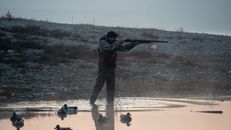
The first confirmed New World screwworm detection in U.S. wildlife was not found by a statewide census or a laboratory team working its way across Texas. It was found after a hunter harvested an elk in Pecos County.
That detail matters more than the novelty of the case itself. It shows how wildlife surveillance actually works across ranches, public land and rough country: agencies can set traps, release sterile flies, fly drones and run cameras, but they cannot stand beside every animal. Sometimes the first useful detector is the person already in the field.
The U.S. Department of Agriculture’s Animal and Plant Health Inspection Service confirmed the first U.S. wildlife detection in an elk on a game ranch in Pecos County. USDA said the animal was reported after being harvested by a hunter. The Texas Parks and Wildlife Department identified it as a hunter-harvested female elk and said additional wildlife surveillance was being conducted.
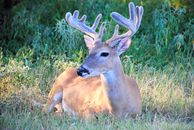
Texas’ general white-tailed deer season begins November 7, 2026. That means thousands of hunters will soon be examining animals in the field, often far from a state office or a paved road. The practical message is not that every deer is now suspect. It is that inspection and reporting have become part of competent field handling.
One elk is not a statewide deer infestation
The confirmed elk case establishes that wildlife can be affected and that hunters can help find cases. It does not establish that New World screwworm is spreading through Texas’ free-ranging white-tailed deer herd.
Officials still need to determine how the elk became infested, whether exposure occurred locally, whether wild flies are present near the ranch and whether the case represents a single event or evidence of a reproducing population. Those are surveillance questions, not conclusions that can be drawn from one animal.
Before the elk detection, TPWD reported examining approximately 7,200 animals, with 55 considered animals of interest and none testing positive. The department also reported using hundreds of game cameras and working with USDA drone teams across millions of acres. USDA has separately described testing more than 6,600 wild animals across 28 species in high-risk Texas counties without evidence of screwworm. Those figures describe surveillance activity; they do not cancel out the confirmed elk case or prove that every part of the wildlife system is clear.
The Texas Animal Health Commission’s current guidance lists portions of Pecos and other Texas counties under movement restrictions. Warm-blooded animals may not leave an established infested zone without prior authorization and required inspection procedures. Hunters should not assume that a carcass, animal product or other material can cross county lines simply because the hunt itself was legal.
What hunters should look for
Hunters are not being asked to diagnose New World screwworm. They are being asked to recognize an abnormal animal, stop treating it as an ordinary field problem and report it promptly.
USDA advises hunters to watch for:
- Visible maggots or larvae in wounds or body openings.
- Open, draining or enlarging wounds.
- Foul-smelling or decaying injuries.
- Animals that appear weak, lethargic, isolated or distressed.
- Signs around the nose, mouth, ears, eyes or genital areas.
TPWD also advises hunters to inspect a harvested animal before field dressing or moving the carcass. That means looking closely at the eyes, ears, nose, mouth and other mucous membranes, then checking the body, feet and spaces between the toes for wounds, odor or larvae.
Maggots alone do not prove New World screwworm. A wound or unusual larvae is a reason to report, not permission to announce a diagnosis. The right response is to document what can safely be documented, avoid unnecessary handling and contact the appropriate officials.
The sequence matters
In the field, the order of operations is straightforward:
- Observe the animal and note what looks abnormal.
- Inspect the carcass before field dressing or transportation.
- Do not unnecessarily move a suspect animal, carcass or potentially contaminated material.
- Contact TPWD, a local wildlife biologist or a game warden for wildlife cases.
- Follow agency instructions about sampling, treatment, disposal or movement.
TPWD directs suspected wildlife cases to a local wildlife biologist or its wildlife reporting number, 512-389-4505. Livestock and companion-animal cases should be reported through TAHC or a veterinarian.
The field mistake would be to load a suspect carcass, drive it to a processor, move it between ranches or cross a county line before asking what to do. A dead animal cannot recover, but the movement of animal material can still matter to disease-control officials.
Hunters are part of the system, not the cause of the problem
There is a difference between assigning responsibility and asking for useful observation. Hunters did not create the surveillance challenge. They are simply among the people most likely to encounter wildlife closely enough to notice something wrong.
TPWD has described a network of approximately 12,000 landowner and manager contacts covering about 32 million acres, along with game wardens, biologists, trail cameras, drone surveys and public outreach. That is a substantial system. It is still dependent on people seeing the right thing and reporting it accurately.
The hunter who found the Pecos County elk was not merely a customer of wildlife management. In that moment, the hunter was one of the people doing wildlife management.
That is also why instructions have to be usable. A reporting number buried in a document is not much help to someone standing over a carcass before daylight. A movement rule that hunters, processors and taxidermists interpret differently is not a strong control. The agencies need clear, consistent guidance that works on a phone, in a regulation book and in the hands of a person who is tired, cold and trying to make the right decision.
Surveillance is necessary, but it is not eradication
New World screwworm was eradicated from the United States in 1966 through surveillance, treatment, movement controls and the sterile insect technique. The current response uses many of the same basic tools: sterile-fly releases, trapping, animal inspections, wildlife monitoring, movement restrictions, wound treatment and public education.
Those tools give officials a way to find and contain the parasite. They do not make one detection insignificant, and they do not prove that the problem has been eliminated.
The distinction is important for hunters. They should neither panic over every unusual wound nor shrug off a suspicious animal as somebody else’s job. The useful middle ground is competent observation: know what healthy animals and ordinary carcasses look like, recognize when something is outside that pattern, and report it before the situation becomes harder to trace.
Wildlife agencies cannot manage what they cannot see. In difficult country, the first detector is often not a machine or a specialist. It is the person who knows what a normal animal looks like and stops long enough to notice when something is wrong.