A new study does not show that lunar or Martian dust makes human exploration impossible. It does show why dust should be treated as an occupational health hazard and a mission-design problem, not merely as an unpleasant housekeeping issue.
In research published online in Communications Biology on November 6, 2026, scientists exposed human airway cells and mice to lunar and Martian regolith simulants. The experiments found weakened airway-barrier function, inflammatory signaling and, in mice, changes associated with immune-cell recruitment and fibrotic responses. The lunar simulant known as LMS-1 produced particularly strong effects in some airway-cell and animal experiments. The Communications Biology study describes a plausible biological hazard under laboratory conditions.
That is important evidence. It is not yet a clinical risk estimate for astronauts.
What the study actually measured
The researchers used several levels of testing rather than relying on a single cell-viability measurement. They examined human airway epithelial cells, human peripheral blood mononuclear cells and mice exposed intranasally to the simulants.
The reported effects included damage to cultured airway cells, reduced integrity of the airway barrier, inflammatory responses and changes in lung-fluid proteins. The mouse experiments also showed recruitment of immune cells and increased expression of some genes associated with fibrosis.
Taken together, those findings suggest that the material can interact with airway tissue in more consequential ways than simple, temporary irritation. A damaged airway barrier may allow particles or inflammatory signals to move through tissue more easily, while persistent immune activation could become more important during repeated exposure.
But the study does not establish that astronauts exposed to real lunar or Martian dust will develop chronic lung disease, pulmonary fibrosis or permanent disability. It does not establish a human dose-response relationship, and it does not show that the experimental concentrations and exposure routes resemble conditions inside a lunar habitat or spacecraft.
Simulants are necessary—and imperfect
Authentic airborne Martian dust has not been returned to Earth, and lunar dust is available only in limited quantities. Researchers therefore depend on terrestrial materials designed to approximate the mineral composition or physical properties of extraterrestrial regolith.
That approach is scientifically necessary, but a simulant is not the same material. It may differ in particle shape, surface reactivity, space-weathering products, electrostatic behavior, nanophase iron and other chemically important features. Lunar and Martian dust may also contain compounds that are difficult to reproduce in an Earth laboratory.
NASA’s own discussion of Martian-dust crew-exposure limits treats the available toxicological evidence as incomplete. The agency’s preliminary framework sets a 30-day continuous permissible exposure limit of 0.1 milligrams per cubic meter for Martian dust particles smaller than 10 micrometers, while also stating that the limit must be revised as evidence improves.
The existence of a numerical limit can create an impression of precision that the underlying science does not yet support. A threshold is useful only if NASA knows how the number relates to particle size, composition, exposure duration, repeated missions and clinically meaningful outcomes.
Small particles create a large engineering problem
Particle size matters because the smallest particles can remain suspended, evade ordinary cleaning and penetrate more deeply into respiratory systems.
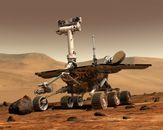
NASA’s Perseverance rover recently measured fine and ultrafine Martian dust clinging to spacesuit-material samples carried on the rover. The Jet Propulsion Laboratory’s report describes particles smaller than 2.5 micrometers and others around 100 nanometers. The measurements do not establish a health outcome, but they confirm that Mars contains dust at sizes relevant to human-support systems.
The smallest particles are also difficult to remove. Larger clumps may fall away from a suit during movement, while finer material can remain attached to fabrics and surfaces. Static electricity can help determine which particles adhere to particular materials, complicating the assumption that brushing or shaking a suit will be sufficient.
This is why NASA has been testing suit materials, coatings, filtration, airlocks and electrostatic dust-removal systems. Its lunar development facilities use regolith simulants to test hardware under conditions intended to reproduce some of the mechanical and operational problems created by lunar dust. NASA describes the material as sharp, abrasive and electrostatically adhesive, with risks to both equipment and crew health. The agency’s lunar development and test facility report places dust control within the broader preparation for Artemis hardware.
From Apollo irritation to chronic exposure
The Apollo missions supplied an early warning. Astronauts reported sneezing, nasal congestion and irritation after lunar dust entered the lunar module. Dust also scratched visors, damaged seals and degraded spacesuit materials.
Those missions were brief. Future exploration is intended to involve repeated surface operations, longer stays and more frequent movement between dusty environments and relatively clean habitats. That changes the central question.
The issue is no longer simply whether astronauts can tolerate some dust for several days. It is whether a spacecraft, suit and habitat can prevent repeated low-level contamination from becoming a chronic occupational exposure over weeks, months or years.
The distinction resembles the difference between an isolated laboratory exposure and a workplace hazard. A single exposure may be tolerable while repeated exposures, incomplete cleaning and limited medical support create a different risk profile. The current study does not answer that long-term question, but it makes the question harder to ignore.
What is known, and what is not
The evidence now supports several careful conclusions:
- Lunar and Martian regolith simulants can damage airway-barrier function under experimental conditions.
- The response can include inflammatory activity rather than simple, short-lived cellular injury.
- Fine and ultrafine Martian dust particles exist and can remain attached to suit-relevant materials.
- Dust control is both a medical requirement and an equipment-maintenance requirement.
- Simulant studies do not establish the human health risk of authentic extraterrestrial dust.
- Animal and cell models do not establish a clinical threshold for astronauts.
- NASA’s preliminary exposure limits remain provisional because the toxicological and operational evidence is incomplete.
There is no serious disagreement over whether lunar and Martian dust deserve control. The legitimate disagreements concern how toxic the material is relative to terrestrial mineral dust, which particle sizes and chemical constituents matter most, whether short intense exposures or cumulative low-level exposures pose the greater threat, and how conservative mission standards should be.
That is not scientific ignorance. It is a reasonably clear hazard signal combined with an incomplete risk estimate.
The standard must follow the mission
A dust limit cannot be evaluated in the abstract. The acceptable exposure for a short lunar sortie may not be acceptable for a crew returning repeatedly from surface work to a habitat. A Mars mission would add longer travel, delayed medical assistance, altered gravity, radiation, confinement and the possibility that a crew could not simply abandon the contaminated environment.
NASA therefore needs more than a single concentration value. It needs mission-specific dust budgets and reliable measurements inside habitats, during airlock operations and after extravehicular activity. It needs to know whether a short-lived post-EVA spike matters as much as a lower concentration sustained for months. It also needs medical monitoring capable of detecting effects before they impair performance or become difficult to reverse.
Engineering controls should be treated as layers rather than as a single promised solution: suitports or equivalent systems to limit suit entry, airlocks that separate dirty and clean zones, filtration designed for the relevant particle sizes, materials that retain less dust, electrostatic removal, procedures for handling contaminated equipment and medical protocols for repeated exposure.
The NASA exposure-limit framework appropriately connects dust standards to filtration, dust ingress, extravehicular activity and habitat environmental control. The unresolved question is whether those systems have been tested together under realistic operational conditions.
Reaching the Moon is not the same as living there
The new study does not provide a reason to abandon Artemis or Mars exploration. It provides a reason to define preparedness more honestly.
A habitat can be pressurized and oxygenated and still be medically unsafe if it repeatedly imports a reactive particulate hazard. A suit can protect an astronaut from vacuum and temperature while also becoming a vehicle for fine dust into the living quarters. A filtration system can function nominally while failing to remove the particles that matter most biologically.
The central question is therefore not whether dust can be eliminated. It cannot. The question is whether mission designers can measure it, contain it, remove it and respond to exposure reliably enough that the risk remains bounded over the duration of a real mission.
For now, the responsible conclusion is limited but consequential: lunar and Martian dust has demonstrated biological activity in laboratory and animal models, and NASA is still converting incomplete evidence into exposure standards and hardware requirements. Exploration remains possible. But working safely in a dusty extraterrestrial environment will require NASA to prove not only that crews can reach the surface, but that the surface can be kept from following them home.