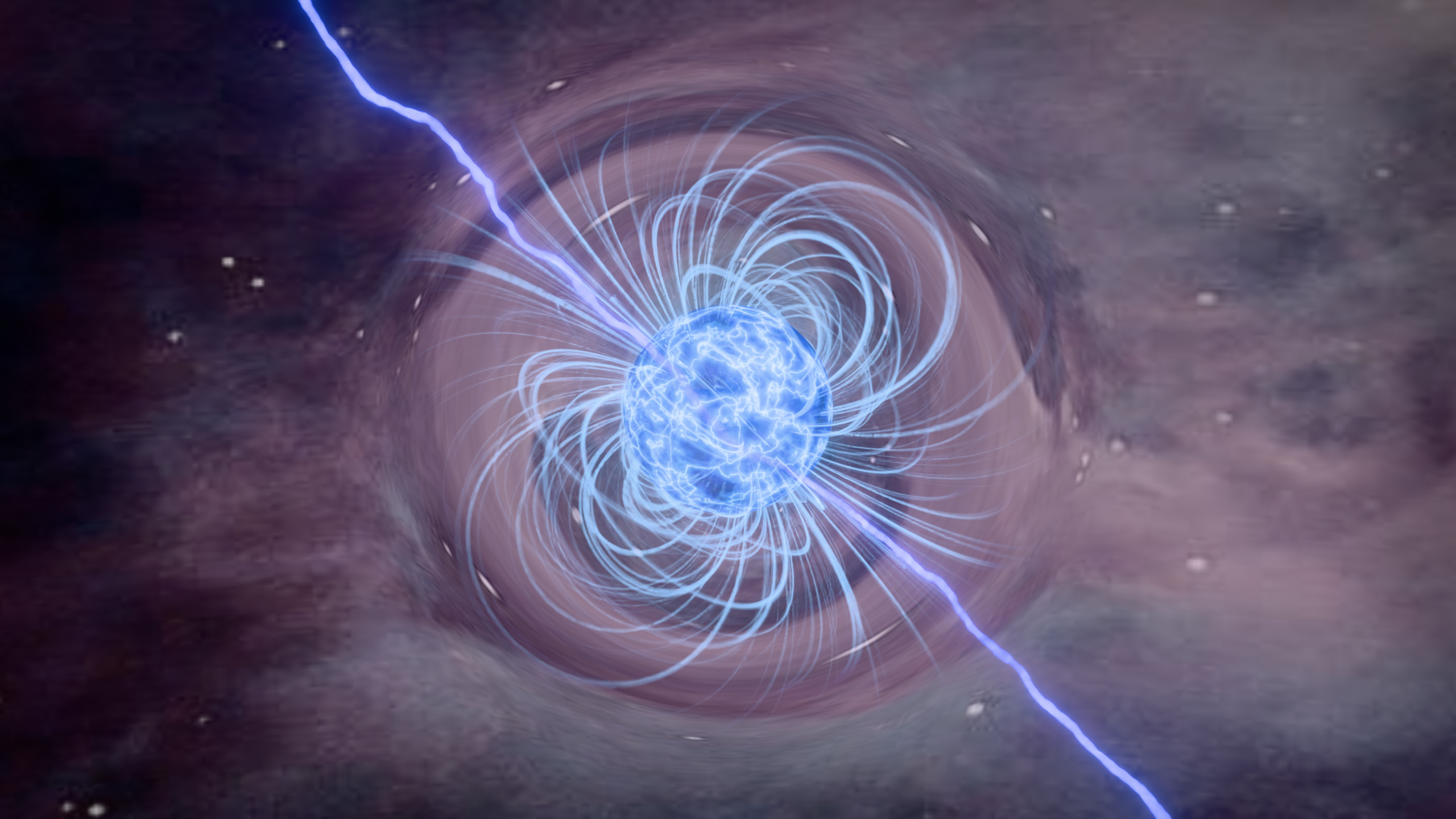
Astronomers have long understood, in broad outline, how a neutron star can feed from a companion star. A massive star sheds gas, and the compact remnant captures part of that outflow, converting gravitational energy into intense X-ray radiation.
The difficult part has been observing the gas as it falls.
A study using the Japan-led XRISM X-ray observatory reports unusually direct spectroscopic evidence of matter moving onto a neutron star. The observation does not photograph a stream of gas or resolve an accretion disk. Instead, it measures the motion of the gas through the energy shifts of atomic signatures in X-ray light.
That distinction matters. In astronomy, “direct” rarely means visible to the human eye. It means that the measurement is closely connected to the physical process being studied, rather than inferred only from brightness changes, timing or a computer model.
The evidence is substantial. It is also limited to one binary system, one flare and one period of observation.
A giant star and a city-sized remnant
The system, known as BP Crucis or GX 301–2, is approximately 13,000 light-years away in the constellation Crux. One member is Wray 977, a blue hypergiant roughly 40 times as massive as the Sun and about 60 times its size. Its intense radiation drives a continuing outflow of ionized gas known as a stellar wind.
The other object is a neutron star: the compressed remnant of a much larger star that exploded long ago. It contains more than a Sun’s worth of material in a body approximately 20 kilometers across. Because it rotates about once every 11 minutes and directs a beam of X-rays toward Earth, it is classified as a pulsar.
The two objects orbit each other every 41.5 days. During part of that orbit, the neutron star passes through a denser portion of its companion’s wind. Its gravity captures some of the gas, producing powerful X-ray flares.
The general model of wind-fed accretion has been accepted for years. XRISM provided a more detailed view of the gas itself.
How X-rays reveal falling matter
XRISM’s Resolve instrument is an X-ray spectrometer. Rather than merely counting incoming photons, it measures their energies with enough precision to distinguish features associated with particular elements and ionization states.
The researchers observed highly ionized iron. Some of the iron lines were shifted toward lower energies. That redshift indicates that the absorbing gas was moving away from Earth and toward the X-ray source. From the size of the shift, the team estimated an inward velocity of roughly 540,000 kilometers per hour, or about 335,000 miles per hour.
This is the central measurement. The gas was not merely present near the pulsar. Its spectral signature indicated motion in the direction expected for material being captured by the neutron star.
The observation became more informative as it continued. According to the study’s abstract, the iron features changed from absorption lines at the beginning of the observation to emission lines later, with a mixed phase between them. The researchers interpret that evolution as evidence that the geometry of the inflowing material changed during the flare—from predominantly inward motion toward a more transverse, potentially disk-like arrangement.
In simpler terms, the gas appears first to have been falling toward the neutron star and then to have become organized, at least temporarily, into material moving around it.
That is a meaningful refinement. Accretion is not necessarily a smooth plunge. Gas carries momentum as well as mass. Depending on the density and direction of the flow, some material can fall nearly radially while some begins to orbit, forming a temporary and turbulent disk.
What the study demonstrates
The strongest conclusion is also the most limited:
During the observed X-ray flare, the spectra are consistent with—and the study characterizes as direct evidence of—matter moving inward and accreting onto the neutron star.
The measurement improves on earlier evidence based on changes in brightness, variations in absorbing material or changes in the pulsar’s rotation. Those observations supported a model of wind-fed accretion, but they did not measure the inflowing gas in the same way.
XRISM’s spectral resolution provided a velocity-sensitive view of material close to the compact object. It also captured the changing relationship between absorption and emission lines as the flare developed. That gives theorists a physical sequence to reproduce rather than only an overall brightness curve.
The result is therefore a useful test of models describing how stellar winds feed neutron stars and how related accretion processes may operate around other compact objects.
What it does not demonstrate
The observation does not show that all wind-fed pulsars behave in the same way.
The study concerns one binary system and one observation, made on February 1, 2025, for approximately 16 hours near the end of a strong flare. The system’s orbit and stellar wind are complicated, and the density of the outflow can vary. A single passage cannot establish that the same sequence occurs during every flare or in every high-mass X-ray binary.
Nor did XRISM directly photograph an accretion disk. The proposed disk-like structure is inferred from the changing spectral lines and from physical models of how gas behaves near the neutron star. That inference may be well supported, but it remains an inference.
This is not a weakness unique to this study. Much of modern astronomy reconstructs events that occur too far away, too quickly or under conditions impossible to reproduce on Earth. The relevant question is whether the measured signal has a sufficiently constrained relationship to the proposed physical process.
Here, that relationship is unusually strong for an accretion observation. It is not unlimited.
Why XRISM matters
XRISM was launched in 2023 as a collaboration led by JAXA, with NASA and the European Space Agency participating. Its Resolve instrument combines an X-ray mirror assembly with a high-resolution calorimeter spectrometer. The mission operates across the soft X-ray range and was designed in part to restore capabilities lost after the failure of the earlier Hitomi mission.
Its importance is not that it makes X-ray astronomy simple. It makes certain previously blurred distinctions measurable.
A conventional X-ray detector might show that a source brightened. A high-resolution spectrometer can begin to show which ions were present, whether the gas was moving toward or away from the observer, how quickly it was moving and whether the emitting and absorbing regions changed over time.
That is the difference between seeing that a cosmic engine is operating and examining how its machinery is arranged.
XRISM has produced results involving neutron stars, pulsars, black holes and hot galactic gas. The mission has also opened a new key-program call, with proposals due in December 2026. That places this observation within a broader effort to make high-resolution X-ray spectroscopy a routine tool rather than an occasional demonstration.
A careful conclusion
Astronomers have not solved accretion. They have obtained a rare and detailed observation of a neutron star capturing material from a massive companion’s wind.
The measured iron lines indicate inward-moving gas, and their evolution during the flare supports a changing flow geometry that may include a transient accretion disk. Further observations will be needed to determine how reproducible that pattern is—during additional flares, at different orbital phases and, ideally, in comparable systems.
Those measurements can test whether the changing spectral sequence is a characteristic feature of wind-fed pulsars or a particular behavior of GX 301–2.
What we know is that matter was moving toward a neutron star and leaving a measurable trace in X-ray light.
What we suspect is how the flow rearranged itself on the way down.
The difference between those statements is not pedantry. It is the boundary between an observation and the model built around it.
Sources: Science Advances; NASA; NASA HEASARC; XRISM/JAXA.