
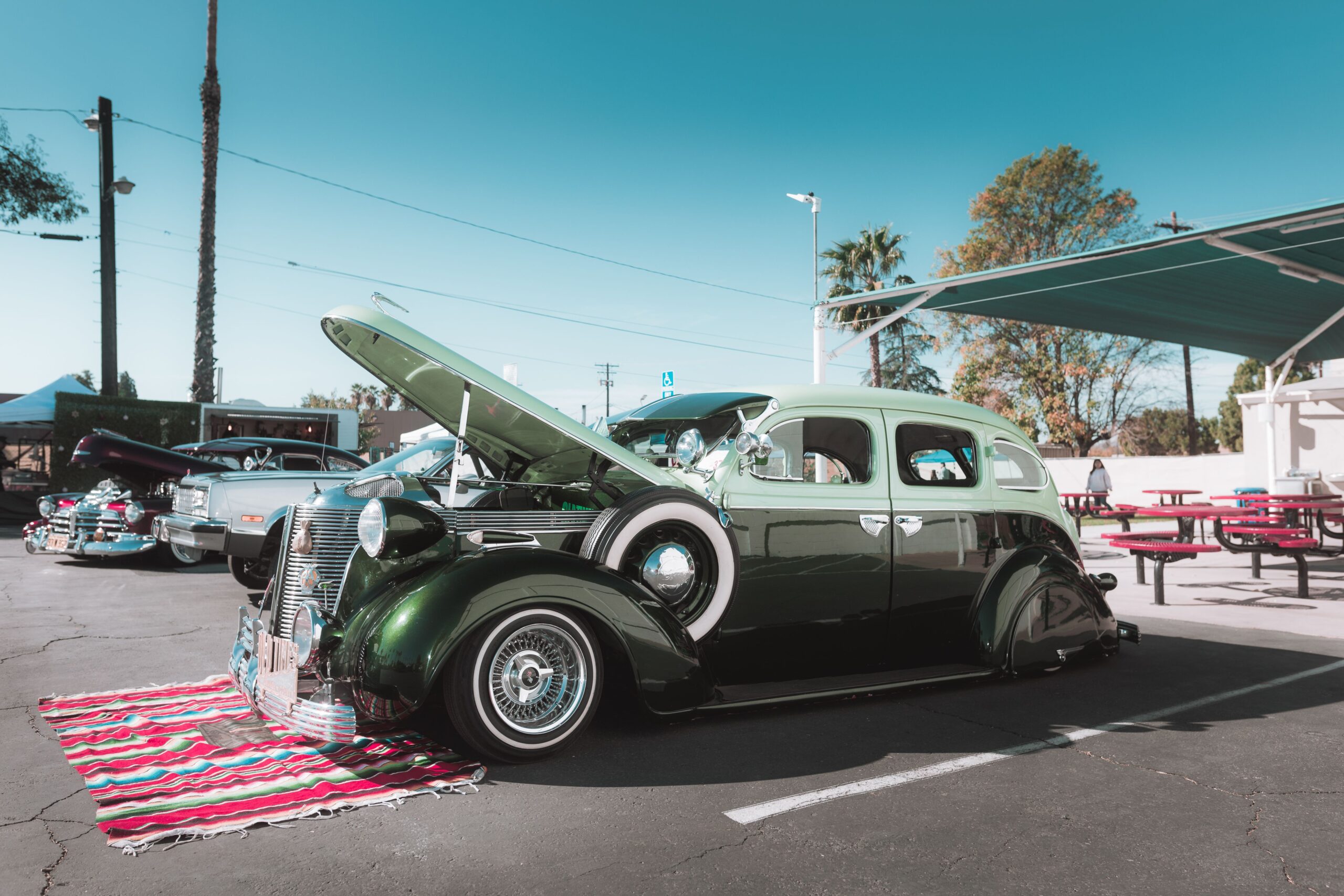
Two Chevrolet Impalas now sit inside the National Museum of American History: El Rey, a 1963 model, and Gypsy Rose, a 1964 car associated with the television series Chico and the Man. Their paint, proportions and mechanical ingenuity can be examined at a visitor’s leisure. Their original purpose was rather different. They were meant to move through public space, gather attention and carry the presence of a community with them.
That tension gives the Smithsonian’s new exhibition, Corazón y vida: Lowriding Culture, its real importance. The 5,000-square-foot exhibition opened on September 26, 2026, and will remain on view through October 2, 2027. A public festival is scheduled for September 27. The Smithsonian’s National Museum of the American Latino announcement describes the exhibition as an exploration of lowriding’s artistry, history and cultural significance through cars, photographs, posters, clothing, trophies, tools and related objects.
The exhibition is welcome. It is also a test.
The museum is not discovering lowriding
Lowriding has been part of American visual culture for generations. Its imagery has circulated through magazines, films, television, music videos, advertising and car shows. Its history has been documented by photographers, scholars, community organizations and the people who build, maintain and drive the cars.
What is new is not the culture itself but the institution recognizing it. Lowriding is being presented inside the country’s principal history museum not as a regional automotive curiosity, but as a national cultural formation. The Smithsonian is placing mechanical modification, visual design, family memory, religious devotion, music, fashion and political identity within the same frame.
That is a meaningful correction to the old hierarchy of cultural seriousness. It is also worth noticing that lowriding has had to wait for a national museum to explain why it matters. The need to prove that a lowrider is art is itself evidence that museums have traditionally defined art too narrowly.
But the stronger claim is not that lowriding belongs in a museum because a customized car can resemble sculpture. It is that lowriding has always been a form of cultural production: skilled, social, autobiographical and public.
A car is not only a car
Lowriding developed among Mexican American and Chicano communities, particularly in the postwar American Southwest and West. As the National Museum of American History’s historical description explains, the practice became connected to cultural identity and, during the Chicano Movement, to political and social self-definition.
The cars may carry images of Mexican and Indigenous heritage, Catholic devotion, ancestors, neighborhoods, music, political history and family life. They appear at weddings, quinceañeras, funerals and community gatherings. A lowrider can therefore function as sculpture, engineering, painting, autobiography and public performance at once.
Its meaning depends partly on circulation. The car is not simply made to be looked at; it is made to enter a relationship with the people who see it. It announces care, memory and belonging. It may also announce defiance: a refusal to accept that the visual language of one’s community belongs outside the official account of American life.
This is why the museum’s central contradiction cannot be dismissed as a clever curatorial detail. The Smithsonian preserves the car by immobilizing it. It protects the object while suspending one of the conditions that made the object culturally meaningful.
Preservation is not possession
Museums do not necessarily destroy the cultures they collect. They can preserve materials that might otherwise disappear, offer conservation resources, provide historical legitimacy and bring subjects to audiences that community institutions cannot always reach. The Smithsonian’s national platform matters, particularly for a culture that has often been stereotyped before it was understood.
Yet institutional recognition can also become a form of containment. A living practice becomes “heritage” at the moment when its makers risk losing authority over how it is described. A car behind glass is easier for an institution to manage than a cruising route, a family workshop, a neighborhood gathering or an argument over who belongs in a city.
The museum’s challenge is therefore not merely to display attractive objects. It must preserve enough of the culture’s movement, argument and social infrastructure that visitors do not leave believing lowriding is a finished chapter.
The related traveling exhibition, Lowrider Culture in the United States / Cultura Lowrider en los Estados Unidos, being organized through the Smithsonian Institution Traveling Exhibition Service, the National Museum of American History and the National Museum of the American Latino, may be especially important in this respect. The Smithsonian’s traveling-exhibition announcement presents an opportunity to take the story beyond Washington and into communities where lowriding developed and remains active.
That opportunity should be taken seriously. A traveling exhibition can become a national template imposed from above, or it can become an invitation for local histories, regional differences and contemporary practitioners to complicate the official version.
The difference between an object and a practice
The Smithsonian has recently made a broader argument that American museums should take popular and vernacular culture seriously. That argument is necessary. The visual world most people inhabit is not confined to paintings in traditional galleries. It includes television, illustration, clothing, cars, music, advertising, comics and the objects through which families remember themselves.
But a lowrider presents a different problem from a painting or a film poster. Those objects can be removed from their original setting and remain recognizably what they are. A lowrider removed from its social setting remains beautiful, but its meaning becomes partial.
The distinction matters because museums are not only collecting things. They are deciding what kind of thing each object is. Is the lowrider art, history, labor, identity, technology or evidence of a community’s relationship to public space? The honest answer is that it is all of these, and that no single label should be allowed to make the others disappear.
The exhibition should also make room for what institutional narratives habitually leave out: policing and stereotypes, regional variation, women’s contributions, younger builders and the ordinary labor required to sustain a culture that is often seen only in its most spectacular form.
What the Smithsonian must prove
The exhibition’s success should not be measured only by the quality of its labels or the beauty of its cars. It should be judged by whether it directs visitors toward the people, places and practices that continue beyond the gallery.
That means asking who was involved in selecting the objects and shaping the interpretation. It means asking what happens to the cars after the exhibition closes. It means preserving mechanical knowledge and family memory, not merely the finished surfaces that photograph well. It means allowing lowrider owners, builders, clubs and community historians to remain participants in the story rather than becoming sources whose authority ends when the labels are written.
The Smithsonian does not need to pretend that lowriding is untouched by commerce, fashion or popular entertainment. Nor should it romanticize every customized car simply because the culture has been historically undervalued. Recognition is not the same as admiration without judgment.
But judgment should begin with understanding. The museum should not turn a living culture into a pleasant symbol of diversity, any more than it should reduce lowriding to a history of marginalization. The cars contain beauty, labor, aspiration, memory and conflict. Their value lies partly in the fact that they do not resolve those things into a single message.
A national museum may place the car on a platform. It cannot, by itself, recreate the street.
The most successful version of Corazón y vida will therefore leave visitors looking beyond the display case. It will show that lowriding is not important because the Smithsonian has finally granted it permission to matter. It is important because communities made meaning with machines long before the institution learned how to preserve the image.
Preservation is useful when it points back toward living people. It becomes possession when the image is allowed to stand in for the culture.