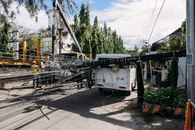
The hurricane has moved on. In parts of Alabama and the Florida Panhandle, recovery is still being measured by generators, satellite systems, water shipments, debris crews and the distance between a resident’s home and the service they need.
A hospital can reopen before every patient can reach it. A county emergency office can regain electricity while its communications remain unreliable. A utility can restore most customers while scattered households wait in the places hardest to reach.
Hurricane Isaias is becoming a test of a less visible question: when officials say a community has recovered, what exactly has been restored?
Restoration is not one milestone
Isaias made landfall near Destin, Florida, at approximately 9:30 p.m. EDT on October 9 as a Category 2 hurricane with maximum sustained winds of 105 mph. Florida declared a state of emergency covering 27 counties, and the state initially reported 439,162 accounts without power.
That first measure was necessary, but it was not sufficient. In the days that followed, public updates showed a region in which different systems were returning at different speeds.
The Alabama Emergency Management Agency reported that an Escambia County hospital was operating on generator power; Monroe County’s hospital had temporarily relied on backup power and satellite systems; Coffee County experienced disruptions affecting emergency operations, 911 dispatch and water wells; and Geneva County suffered severe communications loss, at one point retaining only limited email capability.
In Pensacola, the city’s October 10 recovery update said the Escambia County Utilities Authority had a systemwide boil-water notice in place and that approximately 15 percent of water services remained offline. Nearly 128,420 of Florida Power & Light’s 168,000 Escambia County customers were still without power at 1 p.m. that day. Water had been restored to hospitals, the jail, law-enforcement facilities and fire departments, but restoring critical facilities was not the same as restoring normal service to every household.
Alabama Power’s public storm information described restoration as a process affected by damage, accessibility and the repairs required before crews could safely reach customers. That distinction matters in rural areas, where a main route may be cleared while secondary roads, individual driveways or communications links remain unreliable.
Four different kinds of recovery
For residents, the recovery process has at least four separate milestones:
- Power restoration: electricity reaches a system or customer.
- Facility reopening: a hospital, school, store or government office resumes operations.
- Service continuity: the facility can provide its ordinary services, not merely remain open.
- Community reconnection: residents can reliably reach care, work, supplies, communications and public assistance.
Officials and utilities understandably report the first two milestones. Residents often experience the last two.
A generator can keep a building’s essential equipment running while phones, scheduling systems, laboratory operations or transportation remain disrupted. A water system can restore pressure to a hospital while a broader boil-water notice remains in effect. A road can be passable for emergency crews but still be unsafe or impractical for deliveries, workers and families.
This is not an argument that emergency managers or utilities are reporting inaccurately. It is an argument that restoration percentages describe infrastructure, while recovery describes whether people can resume ordinary life.
The people who feel the gap first
The gap is most consequential for people whose daily lives depend on several systems working together.
That includes residents who use electrically powered medical equipment, dialysis and infusion patients, older adults living alone, families with medically complex children, people who depend on home-health services, and residents who need Medicaid transportation or regular pharmacy access.
Florida officials reported seven health-care facility evacuations after the storm, including four assisted-living facilities involving 282 residents, one nursing-home evacuation involving 83 residents and one hospital evacuation involving 12 patients. Sixty-nine providers reported power issues. State Medicaid managed-care plans said they had contacted approximately 7,500 members with specialized care needs as part of hurricane preparedness and response.
Those figures show the scale of the coordination effort. They do not establish that every affected person experienced a medical interruption, nor do they show whether every need was resolved. They do show why recovery cannot be evaluated through electric restoration alone.
The same problem reaches beyond health care. A small business may have electricity but no water. A worker may have a passable road but no functioning workplace. A family may have a reopened school but no reliable transportation or child-care arrangement. A resident may be eligible for assistance but unable to complete an application because internet, phone service or transportation is still unstable.
Rural isolation is a recovery issue
A recent preprint studying Hurricanes Helene and Milton offers a useful framework, though it does not prove that Isaias produced identical effects. The researchers found that local activity restarted in roughly 4.5 days, while reconnection to the outside world took about five days in coastal-urban Florida and 11 days in inland-rural Appalachia.
The distinction is important. A community can begin moving internally while remaining only partially connected to the outside systems that supply medicine, workers, commerce, information and assistance.
Alabama’s response reports make that possibility concrete. Conecuh County requested communications equipment and a radio tower while dealing with impassable roads. Monroe County’s hospital relied on satellite systems after cellular outages affected emergency communications. Coffee County’s emergency operations and 911 dispatch experienced communications disruptions. Houston County care facilities continued long-term generator operations with only partial service maintained.
These are not signs that recovery failed. They are signs that recovery is layered, and that the last systems to return may be the ones residents need to make the first restored systems useful.
The next test is ordinary operation
Florida’s response included route-clearance teams, mobile command posts, satellite communications, public Wi-Fi hotspots, Starlink kits, water-restoration work and medical-support operations. Those measures provide essential redundancy during the emergency period.
The harder question is what happens when those temporary systems leave.
Can hospitals move from generators to ordinary power without losing service? Can water authorities lift boil-water notices with enough testing and public communication? Can rural emergency offices maintain communications after satellite equipment is removed? Can residents reach pharmacies, clinics, schools and employers without depending on emergency convoys or volunteer networks?
The answers will not be captured by a single outage map. They will require county-level records on water notices, 911 interruptions, hospital and long-term-care operations, road closures, school reopenings, delayed appointments, transportation access and unmet-needs reports.
They will also require listening to residents. Agency status reports can establish what equipment arrived and which facilities were prioritized. They cannot, by themselves, explain whether an older adult reached a clinic, whether a worker lost wages while traveling for medicine, or whether a business could reopen after power returned.
WBC has examined a related problem in Rachel Bennett’s reporting on a rural clinic outage: a facility can have a backup plan while patients lose a usable pathway to care. Isaias broadens that question from one clinic to an entire regional network of roads, utilities, hospitals, communications systems and public agencies.
The lesson is not that generators, restoration crews or emergency declarations are inadequate. The lesson is that they are only parts of resilience.
When officials say a community has recovered, residents should be able to ask a more precise question: recovered for whom, and connected to what?
The storm’s headline has ended. The operational test is whether people can once again obtain care, reach work, receive safe water, communicate with public agencies and obtain assistance without navigating a chain of temporary fixes. That is when recovery becomes more than restoration.