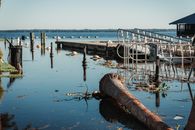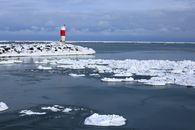
The Great Lakes are losing ice over the long term. But the decline has not been smooth, and a newly reconstructed record shows why recent winters cannot be interpreted without a much longer baseline.
Researchers reconstructed ice conditions on all five Great Lakes from 1898 through 2022 using long-running air-temperature records and relationships tested against modern observations. The result is a record with an important qualification: a roughly 60-year cycle of natural variability has been superimposed on a century-scale warming trend, substantially changing the timing and apparent speed of ice loss.
That does not make warming irrelevant. It makes the baseline more important.
A longer record changes the question
Lake-wide ice observations are relatively recent. Routine satellite-based records begin in the modern era, while earlier information is scattered across weather stations, aircraft observations, paper ice charts and other incomplete sources. The new study therefore does not present 125 years of uniform direct measurements. It reconstructs earlier conditions from air temperatures and statistical relationships calibrated against the period for which better ice observations exist.
The underlying research, published in Communications Earth & Environment, found that the reconstructed Great Lakes ice record contains a prominent multidecadal oscillation of approximately 60 years. The century-scale decline is weaker than the much steeper decline calculated from 1975 through 2022, when the observational record is more robust. The authors associated both long-term trends and shorter fluctuations with the Atlantic Multidecadal Oscillation, a recurring pattern of North Atlantic temperature variability that can influence North American winter conditions. The NOAA Institutional Repository’s record of the study provides the paper, authorship and methodological summary.
The finding is not that the Great Lakes have stopped changing. It is that a short observational window can make a complicated climate system appear more linear than it really is.
What the reconstruction can—and cannot—show
The strongest conclusion is methodological. Great Lakes ice varies substantially from year to year and decade to decade, and a satellite-era record alone may not capture the full range of that variability. A long reconstruction can help researchers distinguish a persistent trend from a temporary phase of a natural cycle.
The evidence is less definitive when it comes to the exact amount of ice present in a particular lake more than a century ago. Air temperature is closely related to freezing, but it is not the same as lake temperature or lake-wide ice concentration. Wind, humidity, cloud cover, radiation, waves, currents, water depth and basin shape also affect whether ice forms and how long it remains.
Those limitations do not invalidate the reconstruction. They define what it is: a tested estimate of historical conditions, not a substitute for direct observations that did not exist.
A separate Scientific Data paper assembled daily air-temperature records from 24 coastal locations and calculated freezing and melting indicators from 1897 through 2023. It also produced spatial estimates of historical ice duration and variability for the earlier period. The dataset is valuable precisely because it makes the assumptions and underlying records available for further testing. The published data descriptor explains how those records were assembled and where the pre-satellite evidence is necessarily indirect.
Natural variability does not cancel warming
Climate discussions often produce two symmetrical errors. One treats every low-ice year as proof that a new and irreversible regime has suddenly arrived. The other treats a temporary increase in ice as evidence that warming has reversed.
Neither follows from this research.
A multidecadal cycle can temporarily increase ice cover while the longer-term background remains warmer than it was in the past. Conversely, a period of unusually low ice can make the recent decline appear steeper than the trend measured across a longer interval. The study’s central contribution is to show how those signals can overlap.
The University of Michigan researchers have made the same point in plainer language: a future increase in ice should not be interpreted as climate recovery, but as a possible temporary respite from a continuing warming trend. The university’s summary of the research also emphasizes that large year-to-year swings make future ice conditions more difficult for communities, businesses and the shipping industry to anticipate.
The lakes are not interchangeable
A basin-wide average can conceal major differences among the lakes. Lake Erie is shallow and generally freezes more readily than the deeper Lake Superior, Lake Michigan and Lake Huron. Lake Ontario has historically experienced relatively little ice cover. A winter that produces meaningful ice in one lake may leave another largely open.
The same distinction applies within each lake. Ice conditions near a bay, port or shoreline do not necessarily represent conditions across the basin. A regional trend can be scientifically useful while remaining a poor guide to a specific harbor, fishing location or navigation route.
That is one reason the reconstruction should not be turned into a simple forecast for the coming winter. The Atlantic Multidecadal Oscillation is statistically associated with Great Lakes ice, but it is not the sole determinant of annual conditions. El Niño, Pacific variability, atmospheric circulation, regional temperatures, wind and lake temperatures also matter.
Ice is more than a winter photograph
Great Lakes ice affects regional weather, ecosystems and human activity. Ice cover changes how much sunlight reaches the water, influences winter mixing and helps protect shorelines from waves. It also affects evaporation and lake-effect precipitation. The long-term dataset published in Scientific Data notes that reduced ice can contribute to greater evaporation and more lake-effect precipitation, while altering habitat conditions for aquatic species.
Those effects are not uniform or automatic. Less ice does not produce one predictable outcome for every fish population, shoreline or shipping channel. But the physical importance of ice means that a changing and less predictable winter regime matters even to people who never walk onto a frozen lake.
Research on Lake Michigan illustrates why visible ice is only one part of the story. A three-decade record of high-frequency subsurface observations found rising deep-water winter temperatures, a shortened winter cooling period and earlier summer stratification. The study examined different variables from the century-long ice reconstruction, but together the findings show that the lakes’ thermal seasons are changing below the surface as well as at it. The Lake Michigan study in Nature Communications describes those subsurface changes.
The practical lesson is uncertainty with structure
Uncertainty here does not mean that scientists know nothing. Researchers can identify a long-term decline, measure modern ice conditions and detect substantial natural variability. What remains less certain is how much each process contributed during a particular historical interval, how the cycle will behave in the future and how ice changes will translate into local ecological and economic effects.
That distinction matters for planning. Shipping operators, fisheries managers, shoreline communities and recreation businesses need more than a prediction that the lakes are generally losing ice. They need to know how variable the next several winters may be, how conditions differ by lake and location, and how much confidence to place in an estimate derived from indirect historical evidence.
The most defensible conclusion is therefore neither dramatic nor reassuring. The Great Lakes are changing in a warming climate, but warming is not the only process visible in the ice record. Natural variability can alter the timing and appearance of the change without erasing it.
A temporary rebound would not prove recovery. A sharp recent decline would not, by itself, reveal the entire long-term trend. The strongest evidence comes from combining direct observations, historical reconstruction, subsurface measurements and continued monitoring.
In climate science, the baseline is not a technical footnote. It is part of the result.