A museum anniversary usually arrives wrapped in the language of achievement: twenty years, dozens of exhibitions, hundreds of artists, a city’s changing image reflected in the gallery walls. The Museum of Contemporary Art Detroit’s twentieth anniversary deserves that celebration. It also deserves a less ceremonial question.
What, exactly, must a contemporary art museum become when a city begins to rely on it for more than exhibitions?
MOCAD’s anniversary exhibition, 20 Years of MOCAD: A Practice of Multiplicity, brings together more than 80 artists across four related presentations. The museum describes the project as a reflection on two decades shaped by artists, experimentation and Detroit. Its own exhibition materials organize the anniversary around process, architecture, Detroit as material, and art as a practice of community and shared knowledge.
That is a substantial artistic proposition. It is also an institutional one. MOCAD is not merely displaying works made during its history; it is trying to make the relationships that sustained the museum visible as part of the museum’s history.
The difficult middle
MOCAD occupies an increasingly important but uncomfortable position in American cultural life. It is established enough to carry civic expectations, yet small enough that the material conditions of its existence remain plainly visible. It is neither a national museum with a vast endowment and permanent collection nor a temporary artist-run project able to disappear when its founders move on.
According to Michigan Public’s recent account of the anniversary, MOCAD opened in 2006 and remains Detroit’s only contemporary art museum. Its artistic director, Jova Lynne, described the institution as still young enough to remain unruly: a place where artists can test ideas that may not fit the commercial art world or more established museums.
That unruliness is not a decorative personality trait. It is the museum’s reason for existing. Detroit already has major institutions capable of preserving and presenting established art histories. MOCAD’s contribution is different: it gives living artists, local histories and unfinished arguments a place to meet.
But a museum that presents itself as a civic commons must also accept the less glamorous obligations of a civic institution. It needs functioning air-conditioning, accessible entrances, insurance, staff, maintenance reserves, reliable funding and a plan for the next repair that cannot be postponed.
The building beneath the idea
MOCAD temporarily closed its main building in 2025 for essential renovations, including HVAC improvements, and continued programming through Mike Kelley’s Mobile Homestead during the closure. The museum’s renovation announcement presented the work as an investment in the institution’s future and its ability to serve artists and audiences.
That phrasing is sensible. It is also worth taking literally. Infrastructure is not separate from cultural ambition. Temperature, humidity, electrical systems, roofs, elevators and bathrooms are among the conditions that determine whether a museum can preserve work, welcome visitors and pay attention to artists rather than emergency repairs.
The broader museum field is confronting this reality. A 2026 Government Accountability Office report estimated that 85 percent of U.S. museums have deferred-maintenance backlogs and that 80 percent expect those backlogs either to remain unchanged or grow through 2027. The report also found that 77 percent of museums have a building system or facility problem that places collections at risk, while 73 percent reported a potential health or safety concern.
These figures do not make MOCAD representative of every small museum. They do, however, clarify the institutional atmosphere in which its anniversary takes place. Museums are being asked to function as classrooms, gathering places, wellness spaces, civic forums and engines of neighborhood confidence while their physical foundations become more expensive to maintain.
The usual response is to praise resilience. Resilience is a useful word, but it can become a polite way of asking institutions to absorb structural weakness indefinitely.
When “community” becomes a budget line
MOCAD’s language of community is more convincing because the museum’s history is tied to Detroit artists and cultural workers rather than simply to the city’s name as a marketing device. The anniversary exhibition includes roughly 40 Detroit artists, according to reporting by Axios, and places local work beside artists with broader national and international visibility.
That arrangement can do something valuable. It can show Detroit as a site of artistic production rather than as an atmospheric backdrop for outside artists. It can also make cultural inheritance visible: artists teaching one another, institutions preserving unfinished conversations, and older practices reappearing in younger work.
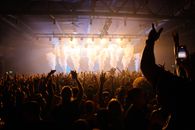
But “community” is not self-explanatory. A museum should be able to identify the people and organizations involved, the work being sustained, the artists being paid and the relationships expected to continue after an exhibition closes. Attendance is useful evidence, but it cannot answer all of those questions. Nor can a photograph of a crowded opening night.
The deeper test is continuity. Does an education program continue after the anniversary? Do local artists receive meaningful commissioning opportunities? Do neighborhood partnerships survive changes in leadership and funding? Does the museum remain answerable to the people whose histories and labor give its civic language substance?
The museum as a relationship, not a warehouse
MOCAD’s non-collecting, artist-centered identity gives it an advantage over institutions built around permanent holdings. It can respond quickly, work with living artists and treat exhibitions as experiments rather than final judgments. Yet this flexibility does not make the museum financially weightless. It shifts the burden from collections care toward programming, production, staffing, artist fees and relationships.
Objects can be catalogued. Relationships require renewal.
That distinction matters in a museum whose anniversary exhibition treats institutional history as part of its subject. MOCAD is, in effect, presenting its own ecosystem: the artists who passed through it, the Detroit histories it has interpreted, the forms of collaboration it encouraged and the arguments it allowed to remain unresolved.
Such an institution should resist the temptation to become merely more respectable. Institutional maturity does not require conventionality. A museum can grow older without becoming tame. Indeed, its legitimacy may depend on preserving the capacity to surprise its funders, audiences and perhaps occasionally its own administrators.
That is a difficult bargain. Funders reasonably ask what their money accomplishes. Public institutions reasonably ask whom a museum serves. Artists reasonably ask whether recognition brings compensation, opportunity and authority or merely another attractive photograph for an annual report.
A museum cannot answer those questions through vocabulary alone. “Civic commons” is an aspiration, not a verdict.
What the anniversary should measure
MOCAD’s twentieth anniversary should therefore be judged by more than the scale of A Practice of Multiplicity. The exhibition may be ambitious, generous and genuinely moving. It may also coexist with financial fragility, staffing pressure or unresolved capital needs. Artistic success and institutional security are related, but they are not interchangeable.
The useful measures will be less glamorous. How much of the anniversary budget reaches artists? What partnerships continue when the exhibition ends? Has the renovation created a credible facilities plan, or merely postponed the next crisis? Can the museum remain accessible when construction costs rise and public funding becomes less reliable? Does Detroit retain meaningful influence over an institution that speaks in its name?
Those questions do not diminish MOCAD’s achievement. They explain why the achievement matters.
The contemporary art museum is increasingly being asked to provide what other institutions have weakened or abandoned: a place for disagreement, local memory, experimentation, public gathering and contact among people who might otherwise remain strangers. That is a noble burden, but it is still a burden. A museum cannot become civic infrastructure by declaration any more than a gallery becomes a community by hanging a neighborhood-themed exhibition.
MOCAD’s anniversary offers a more interesting possibility. Perhaps the contemporary museum’s future will not depend on imitating the large institution, accumulating prestige or pretending that buildings maintain themselves. Perhaps it will depend on making relationships durable enough to survive the next exhibition, the next funding cycle and the next HVAC failure.
Artistic life cannot be preserved simply by putting its traces on a wall. It has to be given room, money, time and institutional protection to continue. That is the real anniversary question—not whether MOCAD has become a conventional museum, but whether it can grow older without surrendering the conditions that made it necessary in the first place.