There is a particular kind of historical object that appears too modest to attract a national argument: a marker, a wayside panel, a sentence on a wall. It occupies little space. It asks for perhaps thirty seconds of attention. Then it disappears, and the landscape seems unchanged.
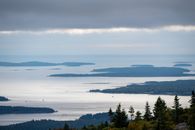
At Cadillac Mountain in Acadia National Park, however, the absence of a Wabanaki marker is not a minor administrative detail. It is a decision about what visitors are permitted to understand while standing in a place that was never culturally empty.
The Associated Press reported on October 22 that a marker explaining Cadillac Mountain’s significance to the Wabanaki people remains missing. It was among roughly 30 interpretive materials removed from Acadia during the federal campaign against park content deemed “disparaging” to American history.
The mountain remains magnificent. The sunrise remains punctual. The granite has not filed a complaint. But a visitor now encounters a thinner account of the place.
A park is never only scenery
National parks present themselves as landscapes, but they are also narrative institutions. Their meanings are organized through signs, maps, place names, ranger talks, visitor centers, museums and decisions about what is left unsaid. A park does not merely preserve land. It tells visitors what kind of land they are seeing and whose presence matters within it.
The National Park Service’s own description of Cadillac Mountain acknowledges that the area is the homeland of the Wabanaki people, who have lived there for thousands of years. Its account of Acadia’s Wabanaki Nations describes travel, fishing, hunting, gathering, trade, place names and continuing cultural connection. The park also states that it maintains a government-to-government relationship with Wabanaki tribes, grounded in law and strengthened by the tribes’ historical, cultural and spiritual relationships with the land.
These are not recent ideological decorations placed over an otherwise uncomplicated American story. They are part of the institution’s own historical understanding.
That is what makes the removal consequential. The question is not whether Wabanaki history exists. The question is whether it should remain publicly visible at a site where that history is inseparable from the landscape.
The mountain has more than one name and more than one history
Cadillac Mountain’s meaning is layered. National Park Service materials identify Wabanaki associations with the mountain and Mount Desert Island while also explaining the later colonial naming after Antoine de la Mothe Cadillac. There is no intellectual necessity to choose between these histories. The responsible task is to explain how they came to occupy the same place.
That kind of explanation is precisely what historical interpretation is for. It does not require every visitor to adopt a single moral response. It requires the institution to resist the temptation to make complexity disappear merely because complexity is inconvenient.
The federal campaign began with the White House’s March 27, 2025, “Restoring Truth and Sanity to American History” directive. The order instructed the Interior Department to restore or alter federal parks, monuments, markers and related materials that the administration judged to perpetuate a false revision of history, minimize historical figures or events, or disparage Americans.
The administration presents this effort as a restoration of truth, dignity and national pride. But the premise contains a revealing assumption: that acknowledging conquest, displacement, racism or exclusion is necessarily an attack on the country rather than part of understanding it.
A national story can include achievement without requiring silence about dispossession. In fact, a national story that cannot tolerate evidence of harm is not confident. It is merely well guarded.
Recognition is not the same as repair
It would be sentimental to suggest that a marker, by itself, gives Wabanaki communities control over their history. Museums and parks have long interpreted Indigenous cultures through institutional categories that did not originate with Indigenous people. Acadia’s relationship with Wabanaki communities has developed through a history of exclusion as well as more recent collaboration.
But the limitations of recognition do not make recognition meaningless. The missing marker mattered because it formed part of an institutional relationship: a public acknowledgment that Wabanaki people are not merely figures from a distant prehistory but living communities connected to the park.
Acadia’s own materials describe the renewal of certain plant-gathering practices after decades in which the federal government prohibited Wabanaki people from harvesting sweetgrass within the park. The park also identifies its partnership with the Abbe Museum and its Cultural Connections in the Park program as part of an effort to make Wabanaki history and contemporary presence visible to visitors.
Remove the marker and one does not erase that history. But one does alter the public terms of the relationship. Reinstall the object tomorrow and the physical absence may be corrected. Institutional trust is less easily replaced.
The danger is caution before censorship
The most important consequence of this campaign may not be the obvious removal of every difficult panel. It may be the caution that precedes removal.
Park employees and interpreters begin to ask not only whether an account is accurate, but whether an official might dislike its emotional effect. Curators become less inclined to propose material that complicates patriotic confidence. Community partnerships become less attractive when they introduce histories that cannot be reduced to national reassurance.
The result can be a public institution that remains visually rich and intellectually evasive: beautiful landscapes, uplifting language, fewer explanations of how those landscapes became national property and whose lives were altered in the process.
This is distinct from the museum problem, though it is related to it. In my recent writing on the Smithsonian’s presentation of lowriding, the central tension was the museum’s attempt to preserve a living culture without immobilizing it into a finished object. At Cadillac Mountain, the issue is more immediate. The institution is not merely displaying a community’s history. It is interpreting the homeland of communities that remain present beyond the federal boundary.
A museum can, at least in theory, add another gallery. A mountain cannot be moved into a more convenient historical setting.
What visitors are allowed to notice
Public interpretation works cumulatively. Most visitors will not remember every sentence on every sign. That does not make the sentences irrelevant. They establish the boundaries of attention. They tell families, school groups and tourists what is worth noticing before the next overlook, photograph or parking-lot negotiation.
A missing panel does not make Wabanaki history vanish from the world. It makes the federal institution less useful as a guide to the place it administers.
The relevant standard is not whether the old marker was perfectly written or whether every visitor found it persuasive. The standard is whether the account was historically grounded, relevant to the site and developed with appropriate accountability to the people whose history it presented.
Nor is restoration simply a matter of returning an earlier sign. An older interpretation is not automatically more truthful because it is older. The goal should be an account that is accurate, candid and responsive to the continuing relationship between Wabanaki communities and Acadia.
The larger question is whether public history must produce emotional comfort in order to remain publicly legitimate. If so, every national park becomes a kind of patriotic theater in which the landscape is permitted to speak only after its difficult memories have been edited.
Cadillac Mountain does not need a sign in order to possess Wabanaki history. The federal government does not have the power to make that history absent. It does, however, have the power to decide whether millions of visitors will be invited to encounter it.
That is why a missing marker is not a small omission. It reveals who is being asked to feel at home in the national story—and who is being asked, once again, to remain visible only when the institution finds the visibility convenient.